

After installation is complete, an asphalt mixing plant must undergo a crucial phase—commissioning and acceptance—before entering full-scale production. Only by verifying the coordinated operation of all systems can the equipment effectively meet the demands for continuous production in subsequent road construction projects.
During the startup of a new plant, key aspects such as cold aggregate supply, the combustion system, metering and control, and mixing quality require step-by-step inspection. Systematic integrated commissioning allows you to assess the equipment’s operational status in advance and prepare for stable production.
This article outlines the commissioning process, common issues, and key acceptance criteria for asphalt mixing plants, helping you clearly navigate the critical steps from equipment startup to stable production.
Why Commissioning Matters for Your New Asphalt Mixing Plant
After the installation of an asphalt mixing plant is complete, multiple system verifications are required before stable production can be achieved. During this phase, by inspecting the coordination between various systems, you can clearly determine whether the equipment’s performance meets project requirements and make necessary parameter adjustments in a timely manner. For a new asphalt mixing plant destined for road construction projects, comprehensive integrated commissioning is a crucial step toward a smooth transition into the production stage.
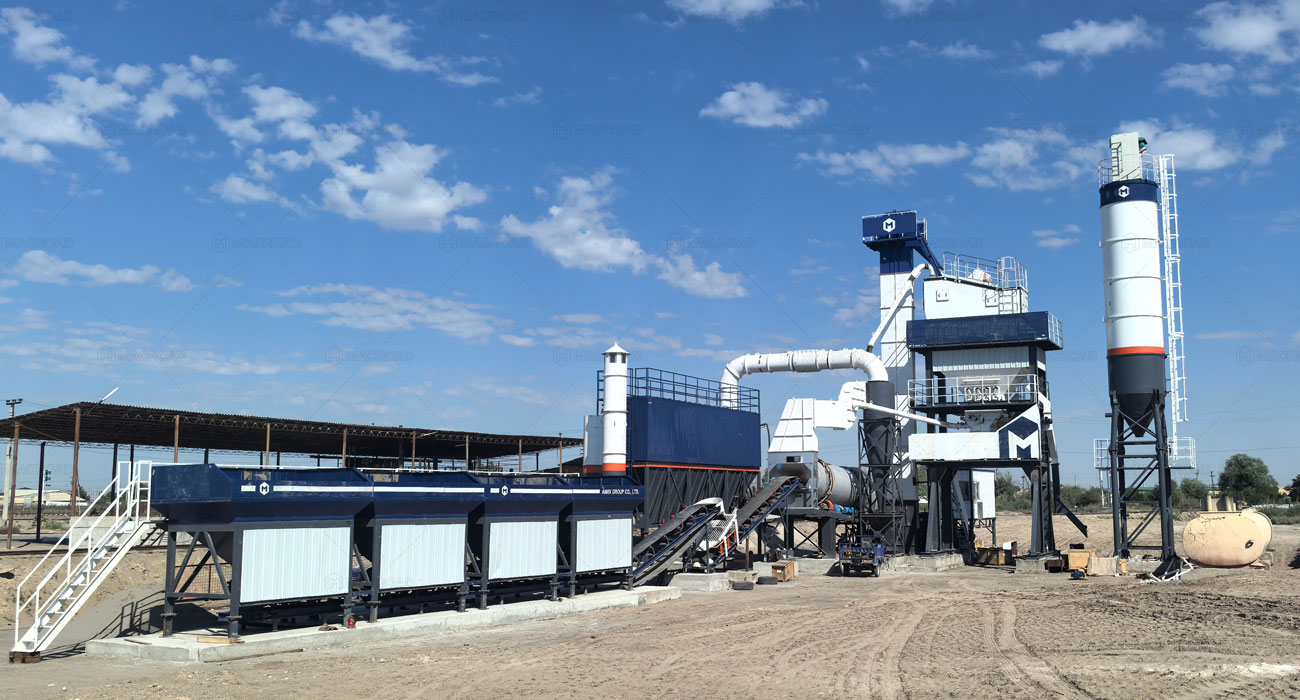
Ensure coordinated operation across production systems
An asphalt mixing plant is an integrated, continuous production system rather than merely a collection of independent pieces of equipment. Stages such as cold feed supply, drying and heating, hot aggregate screening, proportioning, and mixing must work in concert according to a set workflow.Through integrated system testing, you can verify:
- Whether the cold feed rate meets downstream production demands;
- Whether the drying drum’s heating capacity matches the aggregate supply volume;
- Whether the balance between hot bin storage and material discharge is maintained;
- Whether the proportioning system accurately controls material ratios;
- Whether the mixing system completes production according to the programmed sequence.
Confirming the coordination of these systems beforehand helps minimize downtime for adjustments caused by parameter mismatches or workflow integration issues during actual production.
Identify installation and configuration details early
After a new asphalt mixing plant is installed, actual operation is required to verify component connections and identify specific details, such as:
- Whether conveying equipment is running in the correct direction;
- Whether sensor feedback signals are accurate;
- Whether valve operations comply with control requirements;
- Whether electrical system communication is stable;
- Whether component positioning requires further adjustment;
These issues are often most clearly identified during integrated system operation. Addressing these checks before commissioning allows you to resolve problems during the testing phase, avoiding the need to halt operations for adjustments once formal construction begins.
Ensure production parameters meet project requirements
Different road projects have varying requirements for asphalt mixtures; factors such as production capacity, aggregate gradation, discharge temperature, and material proportions all influence the final output.Integrated system testing allows you to confirm and optimize key parameters based on actual project conditions, such as:
- Cold feed bin proportioning ratios;
- Burner system temperature settings;
- Aggregate and filler metering accuracy;
- Asphalt injection volume;
- Mixing time settings.
These adjustments enable the equipment to align more closely with your actual production plan, rather than simply operating on factory default settings.
Verify continuous production capability
Stable material supply is crucial for road construction projects. An asphalt mixing plant must not only complete a single production cycle but also maintain stability during prolonged operation. The integrated commissioning phase helps you verify:
- Whether the equipment can operate continuously;
- Whether system loads are within normal ranges;
- Whether material flow remains smooth and uninterrupted;
- Whether the control system responds accurately and consistently.
These tests provide a comprehensive understanding of the equipment’s operational status prior to actual construction, allowing for proactive production planning.
Provides an opportunity for operators to familiarize themselves with equipment operation
When new equipment is put into service, operators must become familiar with the control system, production workflows, and routine maintenance requirements. Integrated commissioning is not merely an equipment inspection process; it is also a crucial stage for the operations team to gain familiarity with the machinery. Through hands-on operation, staff can learn:
- Operational procedures for different production modes;
- Methods for adjusting control system parameters;
- How to interpret various operating conditions;
- Key points for daily inspection and maintenance.
This enables your team to operate the equipment more smoothly once full-scale production begins and enhances on-site management efficiency.
Reduces adjustment costs after the start of formal production
If a new asphalt mixing plant enters production without adequate commissioning, it may require constant parameter adjustments during actual operations. A comprehensive integrated commissioning process allows you to complete the following in advance:
- System compatibility checks;
- Parameter optimization;
- Operator training;
- Production verification.
This enables the equipment to transition from basic functionality to stable operation tailored to your specific projects, ensuring a smoother and more confident entry into the formal production phase.
The integrated commissioning of a new asphalt mixing plant goes beyond simply verifying whether the equipment can start up; it enables you to determine whether the entire production system operates as intended. By inspecting, adjusting, and validating each stage of the process, you can gain early insight into the equipment’s status and ensure readiness for continuous production during subsequent road construction.
Pre-Commissioning Preparation for Asphalt Mixing Plants: Ensuring Smooth Operation
Thorough preparation prior to integrated commissioning will help ensure a smoother transition to the equipment testing phase. A new asphalt hot mix plant comprises various components—including mechanical, electrical, material handling, and auxiliary systems—and if any single aspect fails to meet operational requirements, it could delay the subsequent commissioning schedule.
Therefore, before officially commencing integrated commissioning, it is recommended that you verify the following areas to ensure the equipment, environment, and personnel are fully prepared, thereby laying a solid foundation for subsequent system testing and stable production.
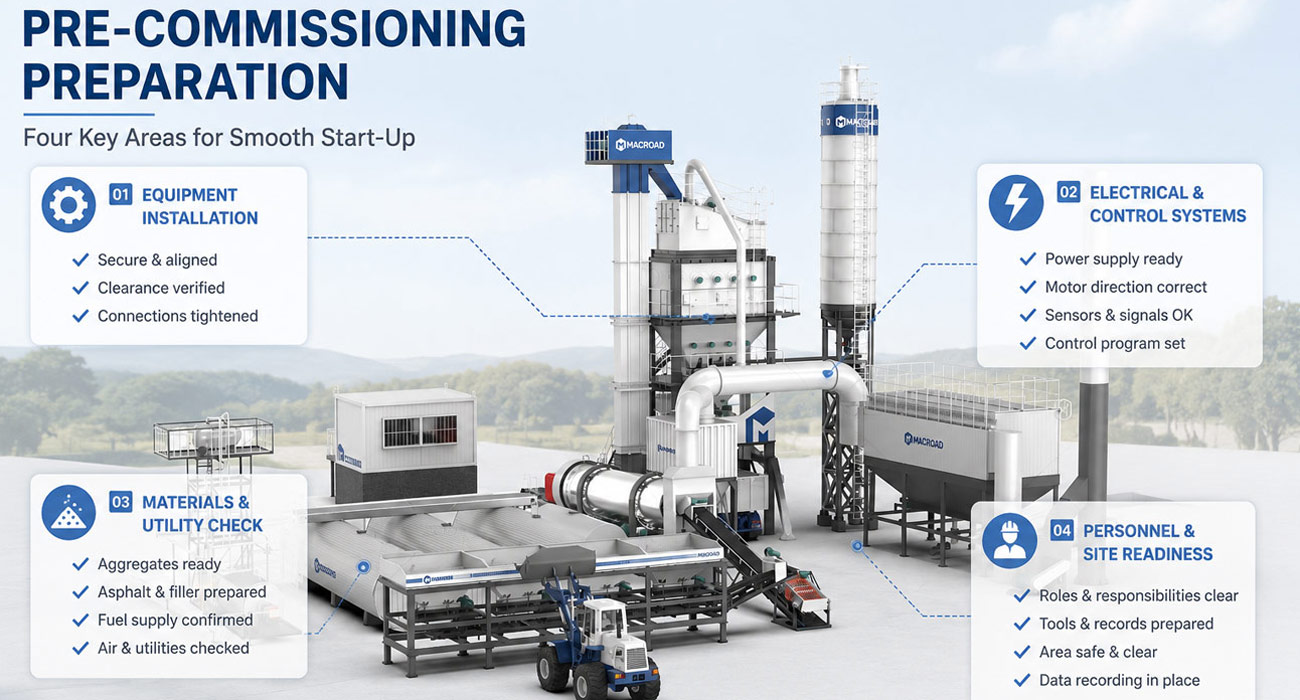
Verification of Equipment Installation Status: Ensuring Mechanical Structures Meet Operational Requirements
After the asphalt mixing plant is installed, the first step is to verify that all mechanical components meet the conditions for normal operation. A proper installation status ensures stable operation during commissioning and minimizes the time required for adjustments caused by installation issues.
Checks required:
- Verify that all major equipment units are connected and secured according to installation specifications: This includes key components such as the main mixing unit, drying drum, vibrating screens, and conveying equipment, ensuring structural stability capable of withstanding continuous operation.
- Check for adequate clearance for rotating and conveying components: Inspect the areas around the drum, belt conveyors, and chain conveyors for obstacles that could impede operation, ensuring smooth equipment movement.
- Verify the tightness of critical connections: Check bolts, couplings, and pipe fittings to minimize the risk of loosening or abnormal vibration during operation.
Verification of Electrical and Control Systems: Ensuring Accurate Response to Commands
Modern asphalt mixing plants rely on control systems to manage production processes; therefore, the status of electrical and automation control systems is a crucial foundation for integrated commissioning.
Checks required:
- Verify that the power supply system meets operational requirements: Confirm that voltage, current, and power connections comply with specifications to ensure a stable power supply for motors, control cabinets, and other electrical components.
- Verify correct motor rotation direction and status: Before integrated commissioning, confirm that the rotation directions of fans, conveyors, pumps, and other equipment match design specifications to prevent production disruptions caused by incorrect rotation.
- Verify proper feedback from sensors and control signals: Check that signals from temperature sensors, load cells, material level detectors, and other devices are accurately transmitted to the control system.
- Verify basic setup of automatic control programs: This includes production workflows, equipment interlocking logic, and parameter settings, preparing the system for subsequent automatic operation tests.
Verification of Production Materials and Auxiliary Conditions: Ensuring a Smooth Testing Process
Integrated commissioning requires not only ready-to-operate equipment but also the necessary conditions for production. Adequate and compliant auxiliary resources enable a more realistic verification of the equipment’s operational status.
Checks required:
- Verify that aggregate supply meets testing requirements: Prepare a sufficient quantity of aggregates that meet project specifications to test the operation of the cold feed, drying, and screening systems.
- Check readiness of production materials (e.g., asphalt, mineral powder): Ensure the metering and mixing systems are ready for comprehensive testing to verify the accuracy of the material addition process.
- Check fuel supply system connections: Verify the supply status of diesel, natural gas, or other fuels to ensure the combustion system operates according to specifications.
- Check compressed air and auxiliary facilities: Inspect air lines, valves, and auxiliary equipment to prevent commissioning delays caused by inadequate external utility conditions.
Personnel and Site Condition Confirmation: Ensuring a safe and orderly commissioning process
Integrated equipment commissioning requires not only technical system testing but also effective coordination from the on-site team. Clarifying personnel assignments and site conditions in advance enhances efficiency and ensures tests proceed according to plan.
Key items to confirm:
- Clarify roles of on-site commissioning personnel: Define the responsibilities of mechanical, electrical, and operational staff before commissioning begins to ensure rapid troubleshooting and issue resolution.
- Prepare testing tools: Ready the necessary testing instruments and data recording methods—such as temperature sensors, measuring tools, and operation logs—based on testing requirements to facilitate accurate equipment status assessment.
- Ensure the operating area meets safety requirements: Confirm the absence of obstacles that could interfere with testing; inspect personnel activity zones, equipment safety guards, and safety warning areas.
- Ensure complete preservation of commissioning data and operation records: Document operating parameters, adjustment processes, and test results to serve as a reference for final acceptance and to facilitate future performance analysis.
Integrated system commissioning is a systematic process; verifying equipment status, electrical systems, production conditions, and personnel readiness in advance helps minimize downtime and the need for repeated adjustments during the procedure.
Once these fundamental conditions are met, subsequent integrated testing of the cold feed, drying and combustion, metering, and mixing systems yields more accurate results and better reflects the equipment’s performance under actual production conditions.
Asphalt Plant Commissioning: Key Checks from Feeding System to Mixing Output
Once the preliminary conditions have been verified, the new asphalt mixing plant will enter the phase of integrated system testing. As the plant operates as a continuous production system, the performance of any single stage directly impacts the quality of the final mixture.
During the actual commissioning process, you can systematically inspect key modules—such as raw material feeding, heating, screening and storage, precision metering, and mixing/discharge—following the production workflow. Verifying the operation of these stages early on helps identify areas requiring adjustment and enables the equipment to gradually achieve the production status required for the project.
| Commissioning Stage | Common Issues | Possible Causes | Inspection and Optimization Direction |
|---|---|---|---|
| Cold Aggregate Feeding System | The feeding speed is unstable, causing fluctuations in the aggregate flow entering the drying system | Changes in aggregate moisture content, poor material flow at the hopper outlet, or the need to adjust feeding parameters | Check the material discharge condition, verify the vibration system and feeding speed settings, and optimize feeding parameters according to actual aggregate conditions |
| The proportion of different aggregate sizes differs from the preset values | Insufficient belt scale calibration, abnormal speed sensor feedback, or improper control parameter settings | Calibrate the weighing system, check sensor feedback, and verify the accuracy of aggregate proportioning through trial operation | |
| Drying Drum and Burner System | Aggregate temperature cannot reach the preset value | High aggregate moisture content, unmatched burner settings, or unstable fuel supply | Check burner operating conditions, fuel supply, and temperature control parameters to optimize the heating process |
| Unstable combustion performance, such as flame fluctuation or temperature variation | Improper air-fuel ratio, unstable fan operation, or parameter deviation in the control system | Check the combustion components, adjust burner parameters, and maintain a stable heating process | |
| Hot Aggregate Screening and Storage System | Uneven material levels in hot bins, with some bins lacking material while others have excessive storage | Improper screen configuration, insufficient screening efficiency, or changes in aggregate flow characteristics | Check screening performance, verify screen condition, and adjust screening parameters according to aggregate grading requirements |
| Blockage or unstable material flow occurs during hot aggregate transportation | Changes in material temperature, issues in the conveying path, or improper equipment connections | Check conveyor operation, confirm material flow paths, and optimize related settings | |
| Weighing and Metering System | The measured quantity of aggregate, filler, or asphalt differs from the preset ratio | Calibration deviation of weighing sensors, inaccurate zero settings, or the need for parameter adjustment | Calibrate each weighing unit, check data feedback, and verify measurement stability during different production cycles |
| The metering system responds slowly under automatic control mode | Control program settings, signal transmission issues, or insufficient equipment response speed | Check control system communication and optimize parameters to ensure the metering process matches the production cycle | |
| Mixing System | The color or consistency of the asphalt mixture is uneven | Improper mixing time settings, uneven asphalt spraying, or material ratio mismatch | Check the mixing cycle and asphalt spraying system, then adjust production parameters according to the mixture quality |
| The discharge process is unstable, causing fluctuations in mixture quality | Mixing blade condition, mixing duration, or incorrect material feeding sequence | Inspect mixing components, optimize the production sequence, and ensure sufficient mixing of all materials |
The integrated commissioning of a new asphalt mixing plant is, in essence, a systematic validation of the entire asphalt production process. Seamless coordination is required at every stage, from the intake of cold aggregates to the discharge of the finished mixture.
By conducting inspections and adjustments in line with the production workflow, you can gain a clearer understanding of the equipment’s operating status and optimize parameters in advance, thereby ensuring a smoother transition to the subsequent acceptance and full-scale production phases.
Asphalt Mixing Plant Acceptance Checklist Before Delivery
Following the completion of integrated system testing, the next step is to verify whether the equipment meets the conditions for full-scale production. For you, the acceptance process goes beyond merely checking if the equipment is operational; it is crucial to confirm that the entire system aligns with project production requirements and is ready for subsequent construction and operational use.
By following these key acceptance steps, you can gain a comprehensive understanding of the equipment’s status and verify that every aspect—from installation and operational testing to production capacity—meets the expected standards.
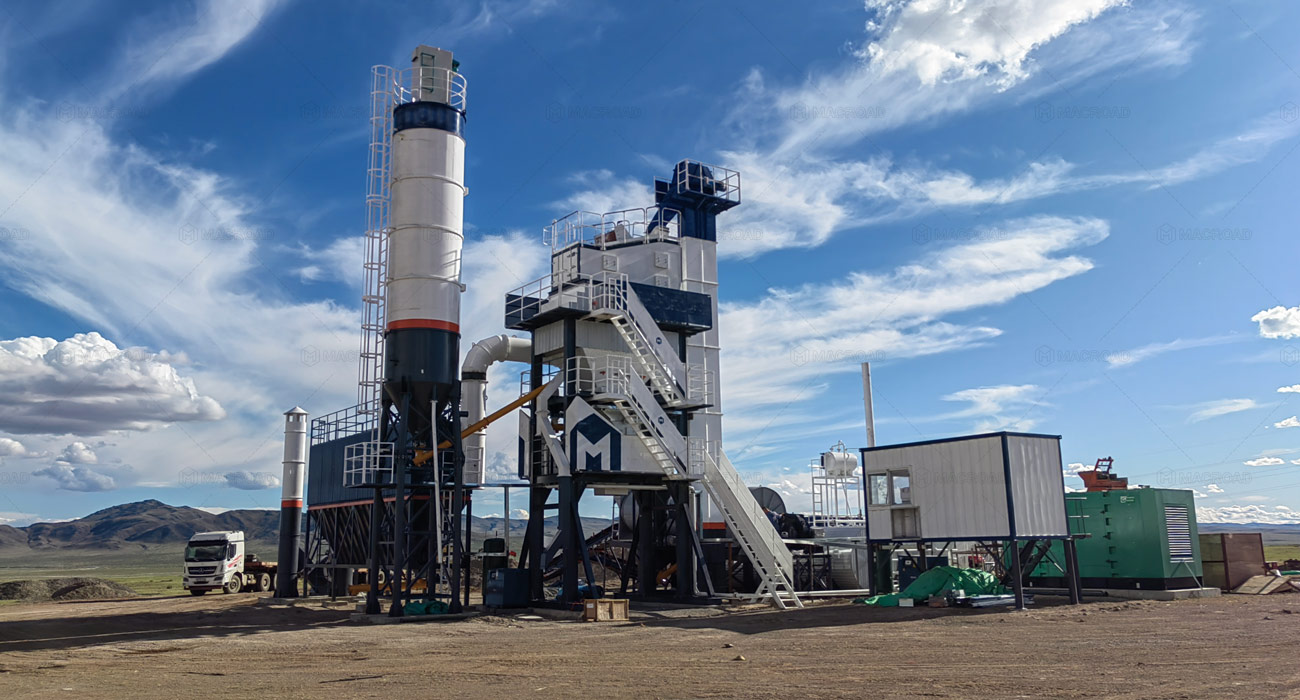
Conduct no-load testing to verify accurate equipment operation logic
No-load testing is primarily used to check the equipment’s operational status, allowing you to verify that the actions of each component align with expectations before introducing raw materials for production.
- Confirm that individual units start and operate in the correct sequence: An asphalt mixing plant comprises multiple pieces of equipment working in succession—such as conveyors, fans, drums, and mixing systems. No-load operation verifies that the start-up logic between these units is properly synchronized.
- Check for abnormal conditions during operation: Pay close attention to operating sounds, vibration levels, and control system alarms to promptly identify areas requiring adjustment.
- Confirm the automatic control system accurately executes operational commands: Testing functions such as start-up, shutdown, and parameter adjustment helps determine if the control system meets the requirements for subsequent production operations.
Conduct production testing with materials to verify the equipment meets actual production needs
Compared to no-load operation, testing with materials more closely simulates the actual construction environment and is a crucial step in assessing the equipment’s production capabilities.
- Confirm smooth material flow throughout the production process: Observe whether aggregates—after entering the system from cold feed bins—successfully proceed through heating, screening, proportioning, and mixing stages to ensure a continuous production flow.
- Check if the mixture quality meets project specifications: Analyze the produced mixture to verify that material ratios, heating temperatures, and mixing quality align with expectations.
- Verify stable equipment operation: Beyond the results of a single production run, observe the equipment’s status during continuous operation, including output fluctuations, parameter stability, and system responsiveness.
Check key performance parameters to confirm the equipment meets design targets
While basic functionality is essential, it is ultimately necessary to confirm that production capacity and control precision align with your project plans.
- Confirm actual output meets design specifications: Continuous production testing reveals the equipment’s actual capacity under real-world operating conditions and determines if it meets construction schedule requirements.
- Confirm the metering system maintains accurate control: Precise proportioning of asphalt, aggregates, and filler materials is critical to mixture quality; therefore, the operational data and stability of each metering unit must be verified.
- Confirm temperature control meets production requirements: Focus on the aggregate heating process and the discharge temperature of the mixture to ensure the equipment can adapt to production needs under varying construction conditions.
Finalizing the Acceptance of Deliverables: Ensuring Comprehensive Reference for Future Use
For you, these materials serve not only the purpose of equipment handover but also enable your team to quickly access accurate information during subsequent operations, maintenance, and troubleshooting.
- Verify the completeness and accuracy of technical documentation: During acceptance, focus on confirming that the operation manual, electrical schematics, equipment configuration list, and other relevant technical documents are complete and match the equipment installed on-site.
- Ensure maintenance information is clear to facilitate future maintenance planning: Familiarize yourself with maintenance intervals, inspection requirements, and recommendations for replacing wear parts so your team can schedule routine inspections in advance.
- Clarify information on key spare parts to safeguard future production schedules: Confirm the models, recommended quantities, and procurement details for common wear parts during the acceptance phase; this allows for proactive spare parts planning, preventing production disruptions caused by delayed component replacement.
Finalizing Personnel Training Acceptance: Ensuring Team Proficiency in Equipment Operation
Equipment acceptance is not merely a verification of the machinery’s condition; it is also a crucial stage for familiarizing your team with the equipment.
- Confirm operators have mastered basic production workflows: This includes equipment startup, production operation, shutdown, and routine inspection procedures, ensuring the team can operate the equipment according to standard protocols.
- Ensure staff understand basic troubleshooting methods: Through training, operators should be able to promptly identify common changes in operating status and collaborate with technical support to resolve issues.
- Ensure training content aligns with actual production needs: Tailor the training to your project’s specific characteristics to ensure the team is familiar with relevant parameter settings and operational practices, thereby preparing them for effective production management.
The acceptance process for a new asphalt mixing plant serves as a comprehensive verification of the installation and commissioning work performed. By inspecting equipment status, validating production performance, and completing the handover of documentation and training, you can clearly determine whether the equipment meets project plans and operational requirements.
Upon completion of all acceptance procedures, the equipment transitions from the commissioning phase to the delivery phase, readying it for subsequent road construction projects.
How to Ensure Successful First Commissioning and Acceptance of Asphalt Plant
The initial commissioning and acceptance of a new asphalt mixing plant involve multiple stages, including equipment configuration, installation status, parameter settings, and on-site operation. Securing professional support early on helps you identify issues quickly, ensure proper system integration, and facilitate a smoother transition to the production phase.
Leveraging extensive experience with asphalt mixing plant projects, Macroad as professtional asphalt plant supplier provides comprehensive technical support—spanning project planning, equipment commissioning, and personnel training—to help your new equipment reach its optimal operating state more quickly.
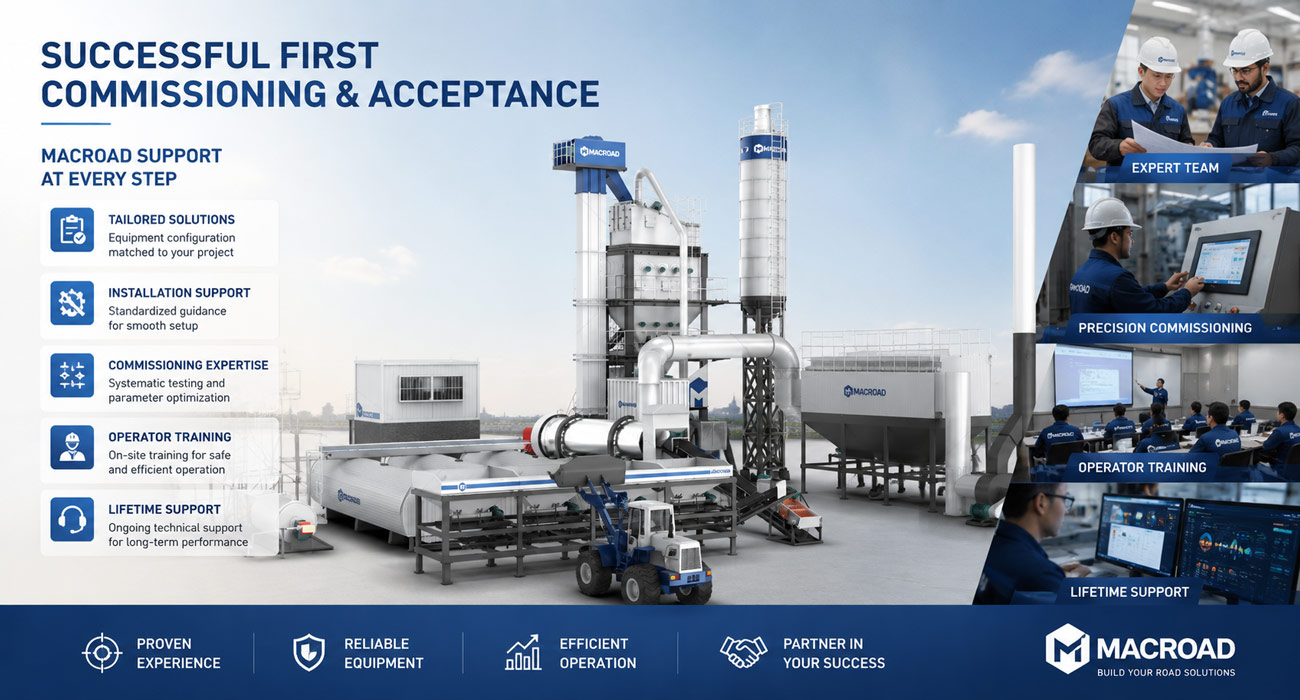
Tailored equipment solutions based on project requirements
- Equipment configuration analysis based on project conditions: Macroad assists in selecting the most suitable equipment solution by considering your production capacity requirements, aggregate characteristics, fuel availability, and construction schedule.
- Proactive consideration of the operating environment: Designs are optimized during the configuration phase to account for regional climate, material properties, and construction conditions, thereby minimizing the need for adjustments during subsequent commissioning.
Standardized installation guidance to reduce on-site adjustment time
- Installation technical guidance: Macroad provides technical support for on-site installation based on the equipment’s structural characteristics, helping to verify the installation locations, connection methods, and assembly requirements for key components.
- Assistance with post-installation checks: Mechanical, electrical, and auxiliary systems are inspected prior to commissioning to identify potential operational issues early on.
Systematic commissioning support to optimize operating parameters
- System commissioning aligned with the production process: Macroad systematically checks the operational status of each stage—from cold feed supply, drying and heating, screening and storage, and metering control to the mixing system.
- Parameter optimization based on actual operation: Operating parameters are adjusted using on-site test data to better align the production process with your specific needs.
Operator training to ensure team proficiency
- Familiarizing operators with the workflow: Through on-site training, Macroad ensures your team is well-versed in equipment startup, production operations, and daily inspection procedures.
- Sharing maintenance expertise: We help your team understand maintenance requirements for key components and how to assess operational status, providing a foundation for effective long-term equipment management.
Ongoing technical support throughout the equipment’s service life
- Prompt response to operational issues: Macroad analyzes the root causes of issues based on operational feedback and provides recommendations for adjustments.
- Monitoring long-term performance: Through continuous communication and technical support, we help you maximize equipment performance and ensure the asphalt mixing plant adapts effectively to your project’s production needs.
The successful initial trial run of a new asphalt mixing plant depends not only on the equipment itself but also on project planning, installation quality, commissioning expertise, and ongoing support.
Macroad provides comprehensive support—spanning solution design, installation guidance, system commissioning, and operator training—to help you minimize uncertainties during commissioning and ensure a smoother transition to stable production.
Turning Your Equipment into a Reliable Solution for Your Project
The construction of a new asphalt mixing plant does not conclude with the completion of equipment installation; rather, it is a process of progressively establishing stable production capabilities through commissioning, acceptance testing, and the launch of full-scale operations. Thorough preparation, systematic commissioning, and rigorous acceptance procedures provide a clear understanding of the equipment’s status, ensuring you are fully prepared for subsequent road construction projects.
For any project, the right equipment configuration, professional technical support, and ongoing operational services form the essential foundation for stable production. Macroad is dedicated to partnering with you throughout the entire lifecycle—from equipment selection and installation to commissioning and full operation—delivering practical asphalt solutions tailored to your specific project needs and enabling you to launch your future production plans with confidence.