


In recent years, with the continuous improvement of requirements for structural load-bearing capacity and service life in road engineering, the raw material system of asphalt mixtures is undergoing significant changes. The application of larger-diameter aggregates and the increase in the proportion of modified asphalt are no longer limited to individual heavy-load or pilot projects, but are gradually becoming the norm.

This change appears to occur at the material level, but in essence, it is reshaping the formation logic and production process of asphalt mixtures. For asphalt mixing plants, the upgrading of raw materials not only means formula adjustments, but also directly translates into a new test of the adaptability of the asphalt mixing plant’s mixing system.
Industry Background: From Traditional Gradation to Structural Asphalt Mixtures
In the current road engineering system, asphalt mixtures are no longer just used for surface paving. With increasing traffic loads, extended design lifespans, and the diversification of road functions, asphalt mixtures are being given more structural load-bearing and durability requirements. Against this backdrop, the application of large-diameter aggregates and modified asphalt is not an accidental technological choice, but an inevitable result of the continuous evolution of engineering needs.
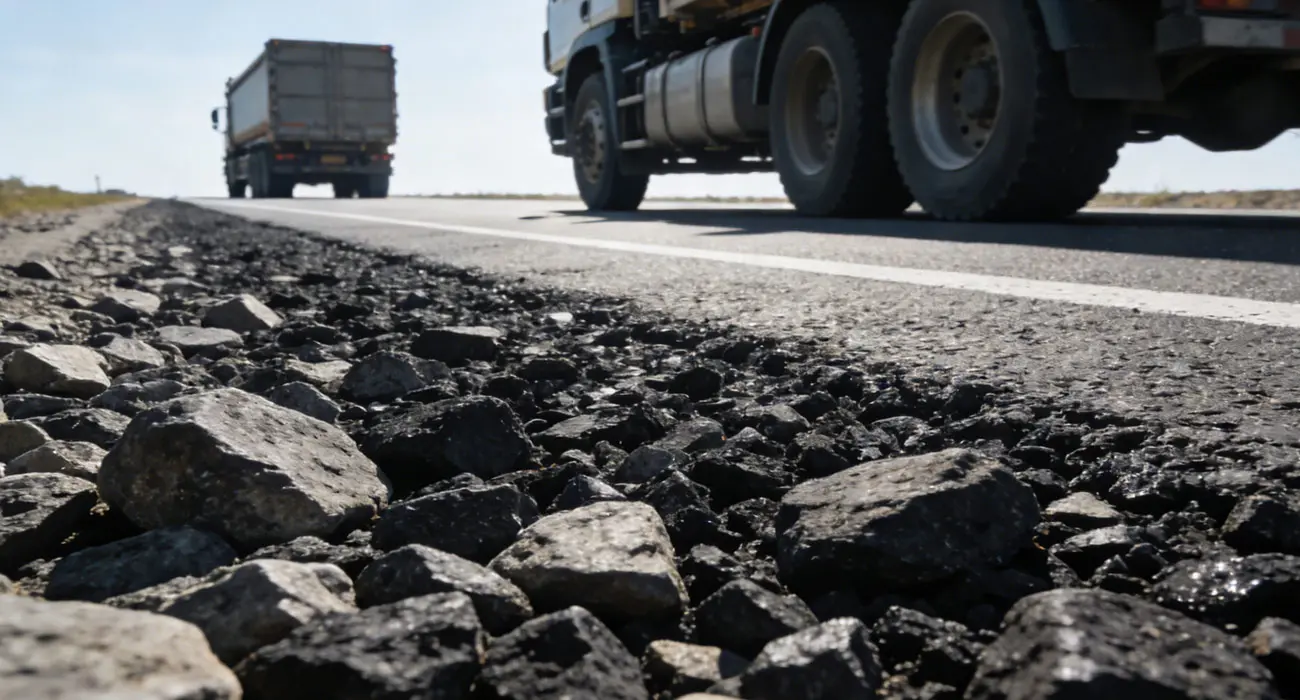
Upgraded Load Capacity: Shifting Road Structure Functions Forward
In traditional pavement structures, load-bearing capacity is primarily borne by the base and sub base layers, with the surface layer focusing more on smoothness and waterproofing. However, in scenarios involving heavy traffic, highways, and industrial roads, the surface layer is increasingly required to participate in structural stress sharing. This change directly drives the application of skeleton-type and structural asphalt mixtures, with larger-diameter aggregates being the key foundation for forming a stable skeleton structure.
Durability Requirements: Significantly Extended Service Life
From usable to long-lasting, road engineering places higher demands on resistance to rutting, fatigue, and aging. Large-diameter aggregates can reduce the risk of internal shear deformation in the mixture, while modified asphalt provides a wider performance safety range by improving high-temperature stability and low-temperature ductility. The combination of these two becomes an effective path to improve overall durability.
Changing Operating Conditions: Heavy Loads and High-Frequency Traffic Become the Norm
Intensive logistics transportation and increased axle load levels expose significant limitations of traditional aggregate systems and ordinary asphalt in long-term service. The enhanced structural stability and bonding properties have prompted engineering designs to increasingly favor large-particle-size aggregates combined with modified asphalt to address high-stress, high-shear conditions.
Standard Evolution: Gradual Relaxation of Material Specifications
With accumulated engineering experience and improved experimental data, relevant design specifications and material standards have been continuously adjusted, gradually relaxing restrictions on maximum aggregate size, gradation range, and asphalt type. This has transformed large-particle-size aggregates and modified asphalt from special options into routine engineering configurations, further promoting their widespread adoption in practical projects.
Under the combined influence of the aforementioned factors, the material system of asphalt production is undergoing substantial changes. However, adjustments to material specifications do not automatically translate into ideal mixing results; the final performance remains highly dependent on the production process itself. To understand the new challenges this change presents to asphalt mixing plants, we must first return to the mechanism by which particle size plays a role in the mixing system.
How Large Aggregates Affect Mixing System Operations
In the production process of asphalt mixing plants, aggregates are not passive fillers participating in the mixing, but rather core elements that directly determine the movement and forming logic of the mixture. Particle size, especially changes in the maximum particle size, profoundly affects the tumbling, shearing, and distribution of materials within the mixing unit. Therefore, when the aggregate particle size distribution changes, the mixing system itself is the first to be affected.
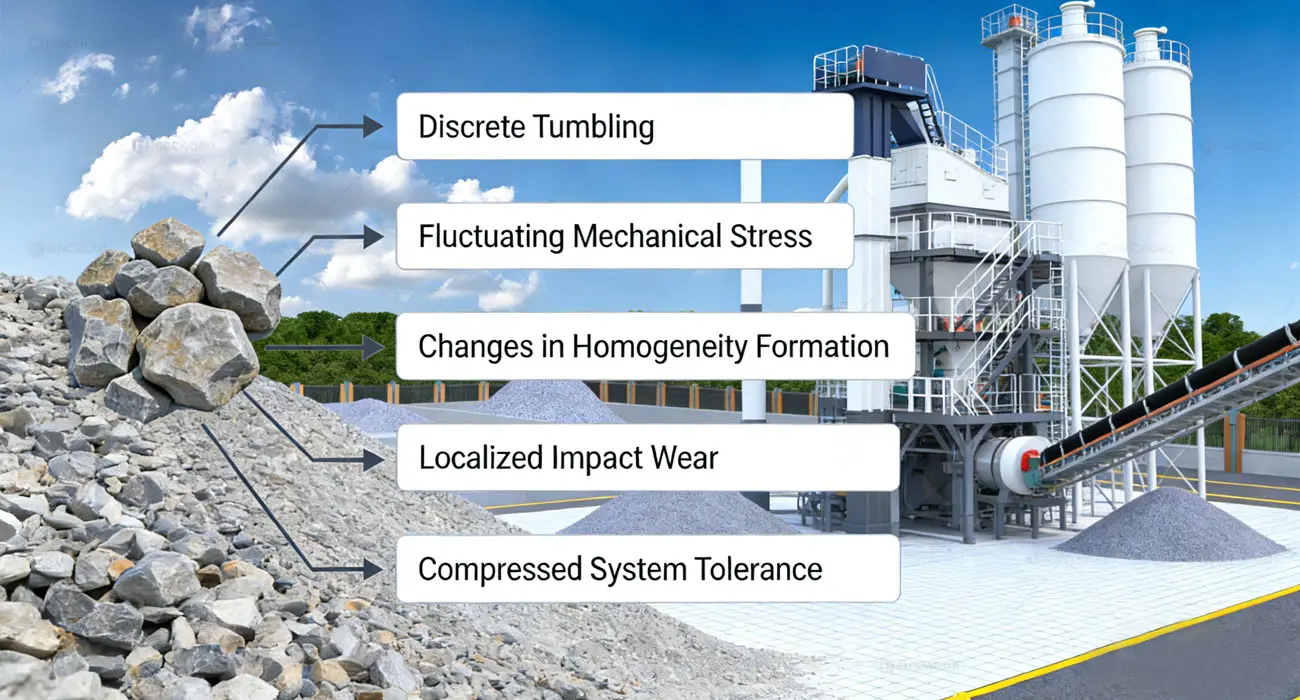
From Continuous Flow to Discrete Tumbling
- Manifestation: Under conventional particle size conditions, aggregates more easily form a continuous material flow within the mixing chamber, achieving uniform mixing through multiple cycles. However, under larger particle size conditions, the volume and mass of individual aggregates significantly increase, and the material tends to participate in motion as discrete units. The mixing process becomes highly dependent on the blade throwing and chamber tumbling capabilities.
- Impact: If the tumbling trajectory design or throwing height is insufficient, some large-diameter aggregates may repeatedly remain in relatively fixed areas, reducing overall mixing efficiency and increasing the risk of localized gradation deviations.
Shift from Stable to Fluctuating Mechanical Stress
- Manifestation: When large-diameter aggregates come into contact with blades and liners during mixing, the resistance and impact forces generated are significantly higher than those of small and medium-diameter aggregates, causing the stress state of the mixing host to shift from relatively stable to fluctuating.
- Impact: Long-term operation under high fluctuating loads not only increases energy consumption but also accelerates fatigue of transmission components and structural parts, weakening the operational stability of the mixing system.
Changes in the Homogeneity Formation Mechanism
- Manifestation: In large-particle-size systems, the number of aggregate particles per unit volume decreases, giving individual aggregates a higher weight in the mixture structure. Their spatial distribution significantly amplifies their impact on the overall gradation.
- Impact: Mixing homogeneity no longer depends solely on extended mixing time, but more on the material’s movement path and redistribution capacity during mixing. Traditional delay compensation methods are limited in effectiveness.
Wear Pattern Shifts from Uniform Wear to Localized Impact
- Manifestation: The contact mode between large-particle-size aggregates and internal components of the mixing system gradually shifts from sliding wear to impact wear, with localized areas experiencing higher frequencies of scouring and impact.
- Impact: Non-uniform wear is more likely to occur within the mixing system, not only shortening the lifespan of critical components but also potentially altering the original material flow lines, indirectly affecting the long-term stability of the mixing effect.
System Tolerance Space Significantly Compressed
- Manifestation: Under large-particle-size conditions, the impact of feed ratio, filling rate, and fluctuations in mixing conditions on the mixing results is significantly amplified.
- Impact: Minor deviations that could otherwise be absorbed by the system may directly translate into differences in the performance of the mixture, significantly increasing the requirements for system consistency and stability during the mixing process.
It can be seen that the introduction of large-diameter aggregates is not a change in a single parameter, but rather places higher and more comprehensive demands on the asphalt hot mix plant mixing system, from material behavior to system operating characteristics. When this change is superimposed on the high viscosity characteristics of modified asphalt, the challenges faced by the mixing system will be further intensified.
Modified Asphalt: Challenges for Mixing Systems
As road engineering demands increasingly higher pavement performance, not only are aggregate particle sizes being upgraded, but the properties of asphalt itself are also changing. Modified asphalt, due to its high viscosity and shear sensitivity, has become an important material for improving high-temperature stability and fatigue resistance. However, these material characteristics place higher demands on mixing efficiency, temperature control, and time management during the mixing process, requiring mixing systems to adapt to new production challenges beyond their original operating conditions.
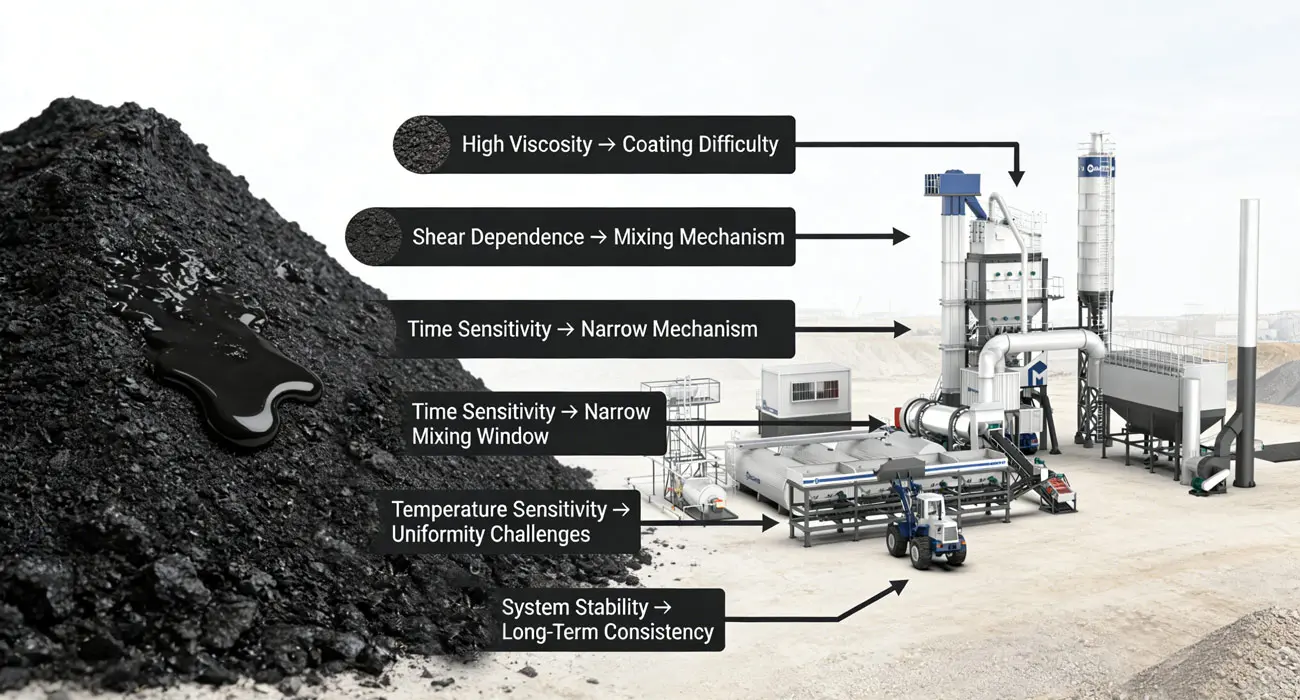
Increased Viscosity Characteristics: A Structural Change in Mixing Difficulty
- Impact on Initial Coating Process: Modified asphalt exhibits reduced fluidity at the same temperature, making it difficult to spread uniformly on the aggregate surface within a short time. If the mixing system cannot provide sufficient mechanical action, discontinuous coating can easily occur.
- Impact on Mixing Efficiency: High viscosity reduces the spontaneous flow capacity of asphalt within the mixing chamber, making the mixing process more dependent on the mixing structure itself, rather than simply compensating for by extending the mixing time.
- Impact on Energy Input Method: To achieve effective coating, the mixing system needs to provide a more concentrated energy input per unit time; otherwise, the mixing process will tend to be inefficient and unstable.
Enhanced Shear Dependence: A Redefinition of the Mixing Mechanism
- Impact on Mixing Method: The dispersion of the polymer structure in modified asphalt depends on continuous shear action; simple material tumbling is insufficient to meet its mixing requirements.
- Impact on Mixing Structure Configuration: The mixing system needs to achieve a synergy between shear and tumbling within a limited space; otherwise, the modified materials cannot fully realize their performance advantages.
- Impact on Mixing Uniformity: Insufficient shear or uneven distribution will directly lead to differences in the internal properties of the mixture, amplifying fluctuations in the quality of the finished product.
Increased Sensitivity to Mixing Time: Traditional Delay Compensation Logic Fails
- Impact on Mixing Time Setting: Modified asphalt requires sufficient time to disperse and is highly sensitive to over-mixing, significantly narrowing the mixing time window.
- Impact on Production Rhythm Stability: Insufficient time control precision directly affects the formation state of the modified structure, reducing batch-to-batch performance consistency.
- Impact on Process Reproducibility: With reduced time tolerance, the stability of the mixing system becomes crucial for ensuring production consistency.
Increased Temperature Stability Requirements: Thermal Control Becomes a Key Variable
- Impact on Temperature Uniformity: Modified asphalt is highly sensitive to temperature changes; localized temperature differences directly affect its flow and shear properties.
- Impact on Mix Quality Stability: Uneven temperature distribution easily leads to differences in coating state, exacerbating fluctuations in the internal properties of the mixture.
- Impact on Process Control Difficulty: Insufficient temperature stability compresses the controllable space of the mixing system, making the production process more sensitive to operational and equipment conditions.
Increased Requirements for Long-Term Consistency: The Stability of Mixing Systems Under Magnified Testing
- Impact on System Structural Stability: Under high viscosity and high shear conditions, any deviation in the system structure will have a magnified impact on the performance of the mixture.
- Impact on Wear and Performance Degradation: Non-uniform wear under modified asphalt conditions more easily alters mixing behavior, affecting the long-term consistency of mixing results.
- Impact on Equipment Adaptability: The routine application of modified asphalt makes the long-term adaptability of the mixing system a crucial factor in equipment selection.
It can be seen that the application of modified asphalt is not simply about improving material properties, but rather about systematically raising the requirements for mixing systems from multiple levels, including mixing mechanisms, process control, and long-term stability. When these changes are superimposed on the working conditions of large-diameter aggregates, the challenges faced by the mixing system will become even more complex.
Combined Effects of Large Aggregates and Modified Asphalt on Mixing Systems
With the increasing demands for high-grade pavements and heavy traffic in road engineering, the combination of large-diameter aggregates and modified asphalt is gradually becoming a common application. Compared to using either material alone, this combination places higher demands on the mixing system. To more clearly illustrate its impact, we can analyze the changes brought about by the superposition of these two materials by examining the key indicators of the mixing system.
| Single-Factor Influence (Large Aggregate + Modified Asphalt) | Key Indicator | Combined Effect / Composite Impact |
| Mixing Uniformity | Combined limitations of aggregate accumulation and asphalt flow reduce overall mixing uniformity, significantly increasing the risk of dry spots and uneven coating |
| Blade Load / Main Motor Power | Peak blade load and motor power requirements rise significantly, increasing system stress and potentially accelerating blade fatigue and wear |
| Temperature Distribution / Thermal Control | Temperature non-uniformity is amplified, reducing local mixing efficiency and increasing thermal control requirements, impacting overall mixture quality |
| Mixing Time Window | Effective mixing time window is compressed, reducing operational tolerance and increasing the precision requirements for process control |
| Wear & Long-Term Stability | Local wear is intensified, reducing mixing efficiency and consistency over time; demands higher wear resistance and proactive maintenance strategies |
The combined effects of large-diameter aggregates and modified asphalt in the mixing system exhibit multi-faceted pressures on system performance: increased blade load, decreased mixing uniformity, enhanced temperature control sensitivity, compressed mixing time window, and aggravated long-term wear risk. Compared to single-factor effects, this complex operating condition not only exacerbates the difficulty of operation and control but also places higher demands on equipment structure and operational stability. Therefore, in the context of current raw material upgrades, the mixing system must be specifically optimized to ensure that the production process can cope with complex operating conditions and maintain stable and efficient mixing quality.
Adapting and Optimizing Mixing Systems for Upgraded Materials
With the widespread application of large-diameter aggregates and modified asphalt in road engineering, traditional mixing systems face new challenges in load-bearing capacity, mixing uniformity, temperature control, and time management. To ensure an efficient, stable, and uniform production process, mixing systems must be upgraded in design and operation strategies to adapt to raw material environments with higher viscosity, shear sensitivity, and changes in material flowability. The following section discusses specific upgrade measures from key optimization directions.

Mixing Structure and Blade Optimization
- Enhanced Blade Design: Utilizing reinforced blade materials and geometry improves impact resistance and wear resistance, while optimizing the tumbling path to accommodate the mixing characteristics of large-diameter aggregates.
- Improved Chamber Layout: Adjusting the internal space and blade arrangement of the asphalt batching plants mixing chamber ensures sufficient contact between aggregates and asphalt during the initial mixing stage, reducing localized dry material and uneven coating.
- Load Management Mechanism: Introducing dynamic monitoring and intelligent adjustment control of blade speed and torque ensures stable main unit power under high viscosity conditions, while reducing the long-term impact of peak impact loads on the equipment.
Temperature Control and Thermal Management
- Uniform Heating System: Optimizing hot material circulation and heating methods ensures temperature uniformity in the large-diameter aggregate accumulation zone, improving the fluidity and coating efficiency of modified asphalt.
- Real-time Temperature Monitoring: Adding multiple temperature measuring points and sensors enables real-time feedback of internal chamber temperature distribution, allowing for timely adjustments to heating power and mixing time.
- Intelligent Thermal Control: Combining with an automatic control system minimizes the impact of temperature fluctuations on mixing uniformity and viscosity, improving the stability of the entire production process.
Refined Management of the Mixing Process
- Dynamic Mixing Time Adjustment: Automatically adjusts mixing time based on material particle size and asphalt viscosity to ensure uniform mixing while avoiding over-mixing that could damage the modified structure.
- Multi-Stage Mixing Strategy: Introduces a multi-stage mixing strategy of initial tumbling + mid-stage shearing + final stage homogenization, ensuring optimal mixing at different stages.
- Process Data Analysis and Optimization: Analyzes mixing efficiency and material flow behavior using historical operating data and real-time monitoring to continuously optimize process parameters and operating strategies.
System Durability and Maintenance Optimization
- Wear Resistance Upgrade for Key Components: Utilizes highly wear-resistant materials or surface treatment technologies to extend the lifespan of blades and liners under high-impact and high-friction conditions.
- Predictive Maintenance: Combines IoT and sensor monitoring to detect blade wear, main unit vibration, and power fluctuations, enabling proactive maintenance and component replacement.
- Operational Reliability Guarantee: Through redundant design and load adjustment, the system maintains stable production even under extreme conditions, reducing the risk of unexpected downtime.
Against the backdrop of raw material upgrades, large-diameter aggregates and modified asphalt have placed a series of new demands on mixing systems, ranging from structural design to process control, and from thermal management to long-term durability. Through blade and cavity optimization, refined management of temperature control and mixing processes, and upgrades to durability and maintenance strategies, mixing systems can effectively cope with complex operating conditions of high viscosity, high shear, and high load, achieving stable, efficient, and uniform production goals.
FAQ: Asphalt Plant Selection under Material Upgrades
When selecting an asphalt mixing plant, what are the main considerations related to raw material upgrades?
With the widespread use of large-diameter aggregates and modified asphalt, does this mean existing asphalt mixing plants are no longer usable?
Does upgrading raw materials necessitate a complete replacement of all equipment?
What impact do raw material upgrades have on production consistency and efficiency?

The application of large-diameter aggregates and modified asphalt has become a trend in road engineering development, placing new demands on mixing systems. However, this does not mean that existing equipment is completely unusable. The key lies in clearly defining the characteristics of raw materials and production needs when selecting or evaluating a mixing plant, and rationally matching equipment capacity with process parameters. With targeted selection and planning, the challenges brought by new materials can be addressed, maintaining production efficiency and mixing quality.