

For any road engineering project, stable asphalt mixture output is crucial for ensuring both production efficiency and construction quality. In actual projects, deviations in mixture uniformity often directly lead to 3%–8% fluctuations in construction quality, while unstable output rhythm can cause an overall production efficiency decrease of over 10%. All of this hinges on the overall performance of the mixing unit. During the operation of an asphalt mixing plant, the true determinant of mixture quality is not the parameter control of a single stage, but rather the comprehensive performance of the mixing unit throughout the entire mixing process.
It undertakes the entire process of material tumbling, shearing, and blending. Its structural form, power configuration, and internal design directly affect whether the mixture is uniform, smooth, and possesses good workability during output. Especially under high-load, high-volume continuous production environments, the quality of the mixing unit’s structure is amplified, ultimately reflected in output stability, energy consumption levels, and equipment operational reliability.
What Are the Key Requirements for the Mixer During the Discharge Phase?
During the discharge stage, the asphalt mixture has completed its proportioning and heating, entering a critical phase before final molding. Its performance at this stage directly reflects the internal structure and operational quality of the mixing unit. To achieve high-quality, stable, and continuous discharge, the mixing unit must meet at least the following core requirements.
Uniform discharge is essential – requiring sufficient and stable mixing capacity
The ideal discharge state involves uniform distribution of the aggregate, thorough coating of the aggregate, and temperature differences controlled within a reasonable range. If the tumbling path is unreasonable or the shear strength is insufficient during mixing, even with precise front-end proportioning, local segregation or temperature fluctuations may occur during discharge.
- Therefore, the mixing unit must possess:
- Sufficient shearing and tumbling capacity
- A reasonable material circulation path
Stable power output. Only with a thorough and balanced internal mixing process can the discharge stage exhibit consistent and stable quality.
Continuous discharge is essential – requiring a smooth, unobstructed structure
In continuous production, the discharge rhythm directly affects the efficiency of the entire production line. If there are dead corners in the mixing chamber, or if the discharge structure is not properly matched with the internal space, material is prone to stagnation or intermittent discharge, thus affecting the production rhythm.
This places clear requirements on the mixing unit:
- The internal structure should avoid dead corners and material accumulation areas.
- The material should circulate smoothly within the chamber.
- The discharge port should be naturally connected to the mixing path.
The smoothness of the discharge essentially depends on the scientific nature of the internal structure.
Stable Discharge – Requiring Structural Consistency Under High Load
Under high-output conditions, the mixing unit operates at high speed and high torque for extended periods. If the shaft structure is unstable or the blades experience uneven stress, fluctuations can easily occur during continuous production, affecting the quality of the discharged material.
Therefore, the mixing unit needs to:
- A reasonably matched power system
- Sufficient structural rigidity
- Maintain synchronous stability between the shaft and blades under high load
Stability during the discharge phase is essentially a reflection of the long-term stable operation capability of the internal structure.
Controllable Discharge – Requiring Precise Matching with System Control
Different projects have different requirements for the mixture; mixing time, speed, and mixing intensity all need to be adapted. If the mixing unit structure cannot precisely match the control system, even with reasonable parameter settings, it is difficult to guarantee consistent discharge.
Therefore, the mixing unit must not only have a reasonable structure but also possess:
- Adjustable operating parameters
- Good coordination with the intelligent control system
- The ability to quickly respond to changes in different operating conditions
The controllability of the discharge is a comprehensive reflection of structural design and system integration capabilities of an asphalt plant.
High-quality asphalt mixtures place holistic demands on the mixing unit. Uniform, stable, and continuous discharge performance depends on the dynamic matching of the mixing shaft, the shearing efficiency of the blades, the smoothness of the cavity structure, and the rational design of the discharge structure. A weakness in any structural component will be amplified during the discharge stage. Truly stable discharge results come from the coordinated optimization of all parts of the mixing unit.
Understanding Performance from the Overall Structure of the Mixing Unit
While it’s widely known in the industry that the mixing host determines the mixing quality, the specific composition and operational mechanisms of its internal structure are often not deeply understood. In fact, the mixing host is not a single component, but rather a collaborative structure comprised of multiple parts, including the mixing shaft, mixing blades, mixing chamber, discharge structure, and power transmission system. Each structural unit directly participates in the material’s tumbling path, shear strength, and discharge rhythm. Only by understanding the operational logic of these core structures can one truly see how the mixing host affects the final performance of the mixture.
Agitator Shaft System: The Core of Power and Mixing Path
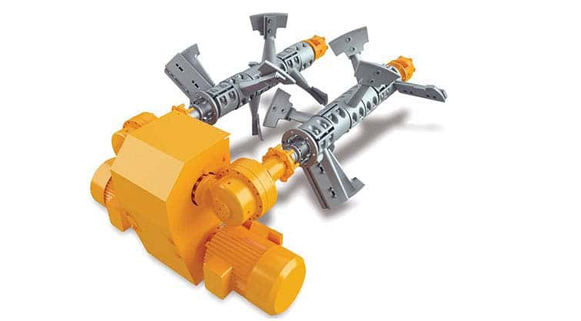
The agitator shaft is the power core of the entire machine. The torque generated by the motor and reducer is transmitted to the blades through the shaft, driving the material to tumble and shear. The number, arrangement, and direction of rotation of the shafts determine the flow path and mixing intensity of the material within the chamber.
The stability of the shaft system structure also directly affects operational smoothness. In high-load continuous production, the rigidity, coaxiality, and power matching accuracy of the shaft determine whether the mixing process remains stable.
Agitator Blade Assembly: The Mixing Unit Directly Acting on the Material
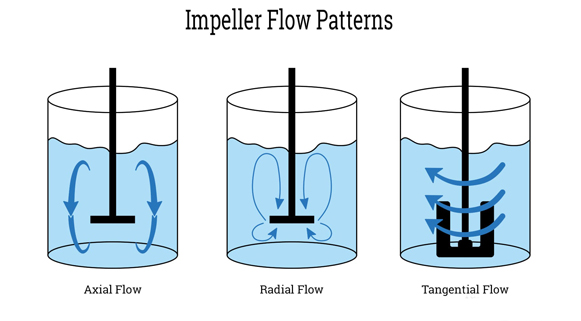
If the agitator shaft provides power, then the agitator blades are the key components that convert power into actual mixing action. The blades, through specific angles and arrangements, cause the material to tumble, convection, and shear.
The geometry, spacing, and installation angle of the blades affect the circulation trajectory of the material within the chamber. If designed properly, the material can form a stable circulating flow field; if designed improperly, mixing dead zones or localized excessive shearing may occur.
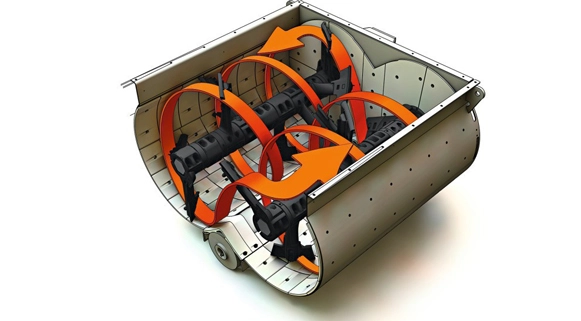
Agitator Chamber Structure: The Spatial Basis for Material Circulation
The agitator chamber provides the mixing space for the material. The volume ratio, internal shape, and inner wall structure of the mixing chamber affect the flow efficiency and retention of materials.
A well-designed chamber should ensure a continuous circulation path for materials driven by the shaft and blades, while avoiding material accumulation and dead zones. In continuous production, the smoothness of the chamber structure directly affects the discharge rhythm and mixing stability.
Discharge Structure: The Final Release Channel for Mixed Materials
Located at the bottom of the mixing chamber, the discharge structure is responsible for quickly and evenly discharging the mixed materials. The size of the discharge port, its opening method, and the angle of connection with the bottom of the chamber all affect discharge efficiency.
An improperly designed discharge structure may lead to material stagnation, flow interruption, or residue, thus affecting continuous production efficiency.
Impact of the Mixing Shaft on Asphalt Mixture Discharge
Among all structural elements of a mixing plant, the mixing shaft is the core component that directly determines the movement of materials. The tumbling path, shear intensity, and circulation rhythm of materials within the chamber are all dominated by the structural form of the mixing shaft. These motion states not only affect the mixing stage itself but also further determine the uniformity, flowability, and rhythmic stability of the mixture upon discharge.
In current engineering-grade asphalt mixing plants, the industry mainstream is the twin-shaft forced-flow structure. This structure, through the coordinated movement of two parallel shafts, establishes a stable three-dimensional flow and distributed shear environment, making the mixing process more balanced and the discharge stage more controllable. Its advantages are mainly reflected in the following four aspects.
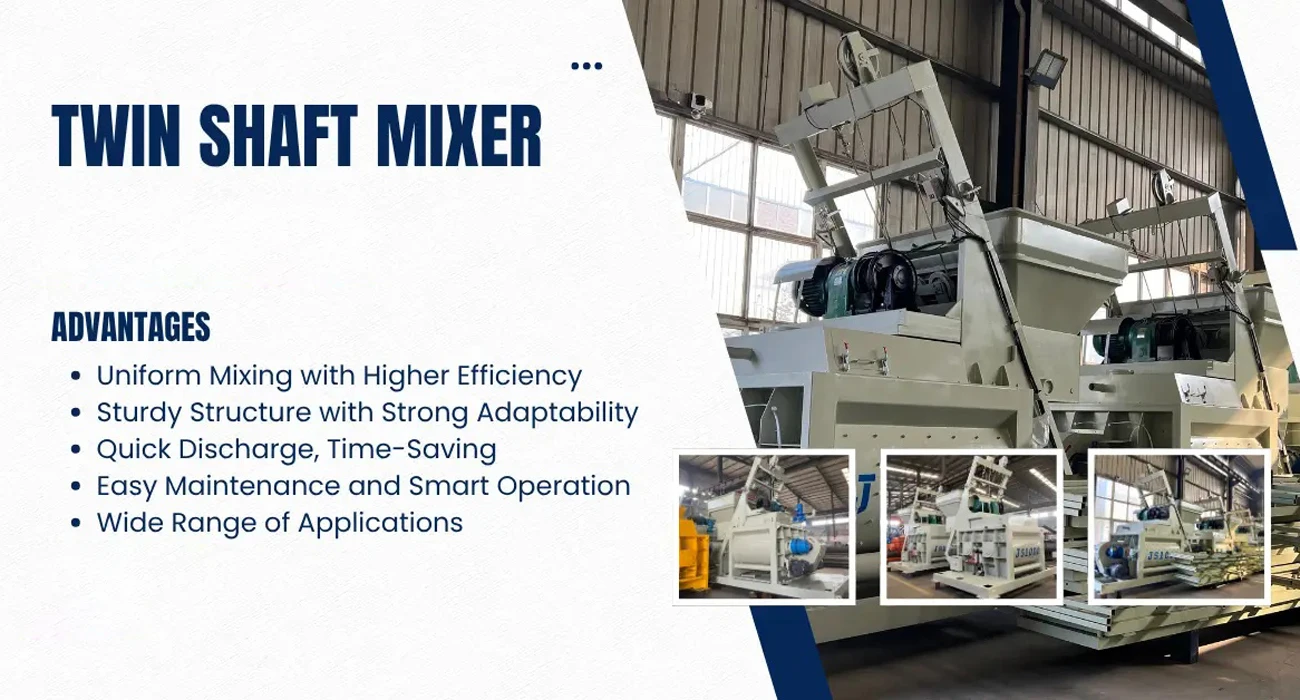
Impact of Cross-Flow Structure on Discharge Uniformity
- Dual-shaft counter-rotating synergistic drive: Two horizontal shafts rotate in opposite directions, forming a continuous material exchange zone between the shafts. This constantly redistributes materials from different areas, reducing local component differences and fundamentally improving discharge uniformity.
- Enhanced lateral convection mixing and exchange: While materials tumble longitudinally, they migrate laterally, significantly increasing the frequency of mixing in different areas of the chamber. This avoids the formation of stable stagnation zones, thus reducing the risk of segregation.
- Stable existence of an inter-shaft shear zone: A continuous shear zone is formed between the two shafts, ensuring more thorough coating of the asphalt stone. A uniform structural foundation is established before entering the discharge stage, resulting in a more consistent state for each batch of mixture.
Influence of Continuous Circulation on Discharge Rhythm Stability
- Forced continuous tumbling path: The blades of the dual horizontal shafts propel materials into a stable circulating flow, keeping the materials in a dynamically dispersed state and avoiding instantaneous concentrated discharge caused by local accumulation.
- Higher material renewal frequency: Due to the continuous throwing and redistribution of materials, there are no long-term stagnation zones within the chamber, resulting in a more balanced material source during the discharge stage.
- Stable Dynamic Flow Field Formation: Under continuous production conditions, the material flow pattern remains stable, reducing fluctuations in discharge velocity and significantly improving batch-to-batch consistency.
Influence of Stress Sharing Mechanism on High-Load Discharge Stability
- Dual-Shaft Torque Distribution Structure: The mixing resistance is shared by two shafts, reducing the stress level on a single shaft and maintaining a stable trajectory even under high aggregate ratio conditions.
- Structural Rigidity Supports Operational Stability: Balanced stress reduces the risk of shaft misalignment and deformation, ensuring a consistent mixing trajectory over the long term, thus guaranteeing stable transmission of the mixing state to the discharge stage.
- Mixing Consistency under High-Load Conditions: In high-volume continuous production, the mixing intensity does not change significantly with load fluctuations, significantly reducing the fluctuation range of discharge quality.
Influence of Distributed Shear Action on Discharge Consistency
- Multi-Area Shear Synergistic Formation: Blades distributed along the dual shafts ensure that shear action covers the entire cavity space, avoiding over- or under-mixing in any single area.
- More Thorough Asphalt-Aggregate Integration: High-frequency cross-shearing allows asphalt to uniformly coat aggregate particles, improving the overall structural consistency of the mixture.
- Equalization of mixing depth: Since different regions participate in shearing and tumbling, the mixing state is more balanced in space, thus keeping the output performance stable between different batches.
The mixing shaft determines the movement of materials within the chamber, thus determining whether the mixing state can be stably transmitted to the discharge stage. The twin-shaft structure, through the synergistic effects of cross-flow, continuous circulation, force sharing, and distributed shearing, achieves more balanced mixing, more stable flow, and more controllable discharge. Under continuous high-production conditions, this structural advantage ultimately manifests as more stable discharge quality and asphalt production rhythm.
How Blade Design Affects Mixing Performance
After understanding the structure of the mixing shaft, it is also necessary to pay attention to another equally crucial component—the mixing blades. The mixing shaft determines the overall movement path of the materials, but it is the blades themselves that truly come into direct contact with the aggregates and asphalt, completing the tumbling and shearing actions. The angle, arrangement, wear resistance, and structural replacement of the blades all directly affect the mixing efficiency, uniformity, and long-term operational stability.
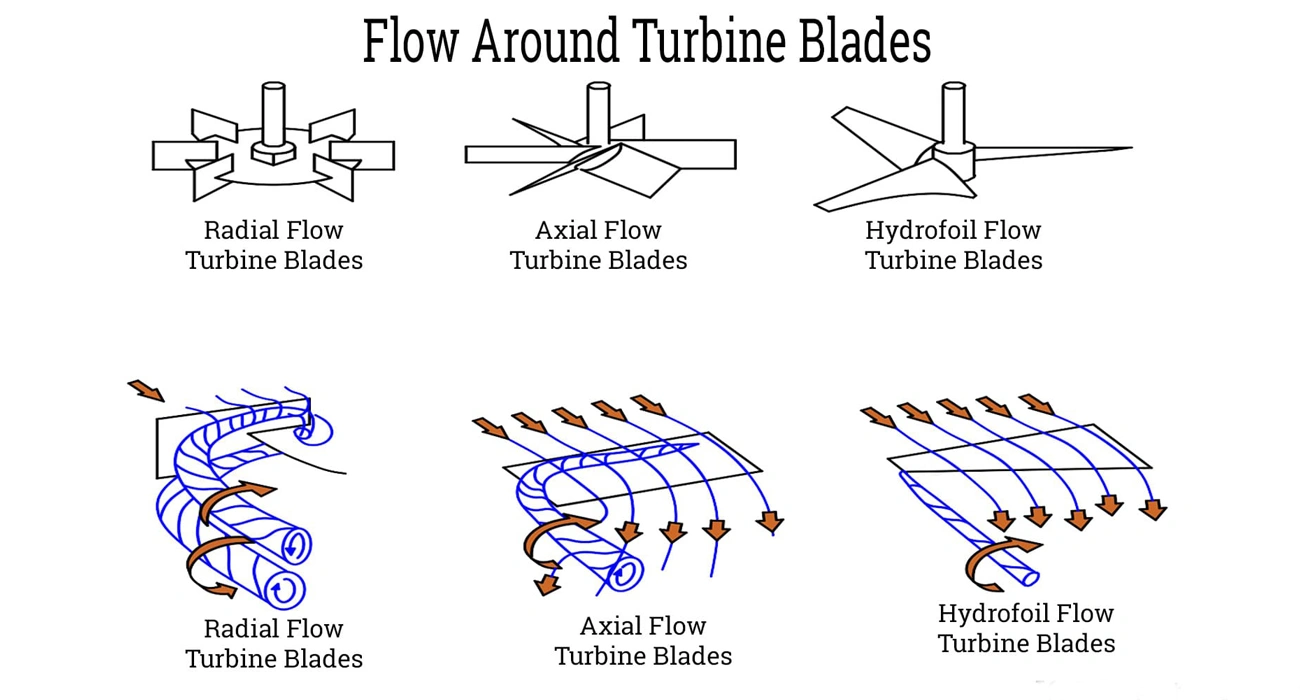
The Impact of Agitator Blade Design on Mixing Efficiency
Blade Angle Determines Material Tumbling Trajectory
Blade Arrangement Affects Shear Strength and Mixing Rhythm
Blade Material Affects Wear Resistance and Stability
Blade and Agitator Arm Connection Method Affects Maintenance Efficiency
Optimization Directions for Mixing Blades
Three-Dimensional Design of Material Tilting Path
Balance Between Shear Frequency and Resistance
Wear Resistance and Shape Stability
Maintenance Efficiency and Structural Precision Maintenance
Reduce dead zones in the mixing process
From the tumbling path to the shearing frequency, from wear resistance to the maintenance structure, every detail of the mixing blades directly affects the mixing rhythm and discharge stability. High-quality mixtures are not simply achieved by extending the mixing time, but are built upon a reasonable blade structure design. Only with a clear motion trajectory, moderate shear strength, and long-term structural stability can the mixing unit maintain stable and uniform discharge performance in a high-load continuous production environment.
Impact of Mixing Chamber Structure on Mixing Stability
After the stirring shaft and blades determine the material movement, the mixing chamber itself truly carries the entire mixing process. The chamber not only determines the material’s carrying capacity but also affects heat retention, flow path, and discharge rhythm. Often, uneven mixing or fluctuating discharge is not due to insufficient power but is closely related to the chamber’s structural design. Therefore, the chamber structure is an indispensable element when analyzing the performance of a mixing unit.
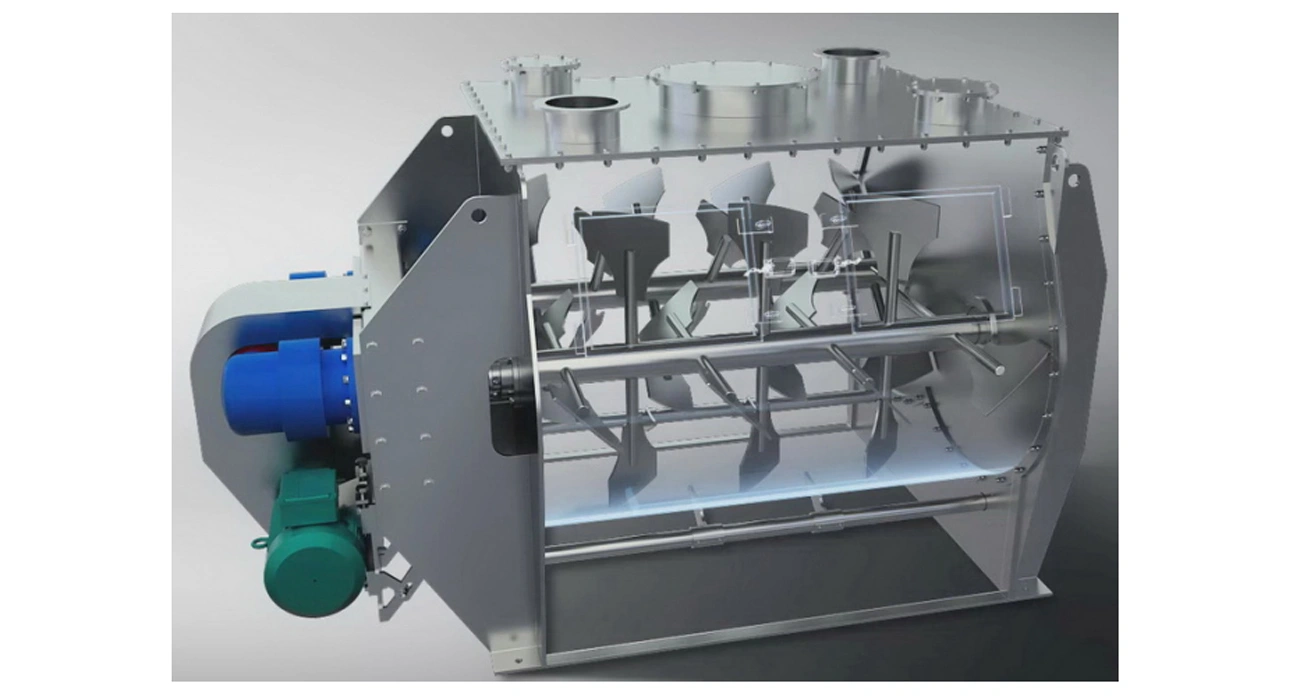
Features of Current Mainstream Mixing Chamber Structures
- Closed Horizontal Chamber Structure: Most mainstream asphalt mixing units currently adopt a horizontal closed chamber design. The interior of the chamber is a long, narrow space where materials circulate, tumble, and shear. This structure facilitates control of the mixing path, allowing materials to undergo multiple tumbling cycles within a confined space.
- Thick-walled Wear-resistant Liner Structure: The chamber is typically equipped with replaceable wear-resistant liners to withstand the long-term impact and friction of high-temperature aggregates. The liners not only provide protection but also participate in material flow guidance to some extent.
- Dual-sided or Bottom Centralized Discharge Port Design: Most chambers adopt a bottom centralized discharge structure, where materials are released uniformly from below after mixing. This method helps to create a relatively concentrated discharge rhythm.
- High-strength Frame Support Structure: The exterior of the chamber is usually reinforced with an integral steel structure to ensure no deformation under high load operation. Structural rigidity directly affects the accuracy of the internal mixing gap.
Analysis of the Advantages and Disadvantages of Chamber Structure
| Advantages | Comparison Dimension | Potential Limitations |
| Enclosed structure helps maintain heat and reduce temperature fluctuations, improving mixing stability | Sealing and Heat Retention | If internal flow design is not well optimized, localized temperature differences may occur |
| Horizontal elongated structure facilitates continuous turnover and improves material participation | Material Circulation Path | If chamber length and shaft spacing are not properly matched, some areas may have insufficient participation |
| Thick wear liner enhances impact resistance and extends service life | Wear Resistance | If liners are not replaced in time after wear, internal dimensional accuracy may be affected |
| High-strength frame support maintains overall stability and reduces deformation during operation | Structural Rigidity | Insufficient rigidity under long-term heavy load may affect shaft clearance accuracy |
| Bottom centralized discharge helps maintain a consistent release rhythm | Discharge Rhythm Control | Improper bottom transition design may lead to material residue or sudden accumulation |
| Modular liners allow partial replacement | Maintenance Convenience | More complex structure may increase maintenance difficulty |
Future Development Directions of the Mixing Chamber Structure
The mixing chamber is the core space in the mixing process, influencing not only the material’s movement path within the chamber but also determining mixing efficiency of asphalt hot mix plant, discharge rhythm, and long-term operational stability. Future development of the chamber structure can be optimized in the following directions:
Improving Material Flow Balance
- Problems and Key Points: Existing horizontal elongated cavities may experience material stagnation in corners or insufficient tumbling, leading to uneven mixing. This is especially problematic with high aggregate ratios, where dead zones can easily create locally unmixed material.
- Optimization Direction: By adjusting the inclination angle of the inner liner, adding guide vanes or auxiliary blades, guide the material within the cavity to form a three-dimensional circulation path combining longitudinal tumbling and lateral convection.
- Ideal Effect: Material participates in circulation in all areas within the cavity, resulting in uniform discharge of the mixture. During continuous production, the discharge rhythm is stable, reducing localized material stagnation or fluctuations in finished product quality.
Enhancing Structural Rigidity and Dimensional Accuracy
- Problems and Key Points: Under long-term high-load or high-output operation, the cavity may undergo slight deformation, leading to changes in the gap between the stirring shaft and blades, and deviations in the mixing path.
- Optimization Direction: Strengthen the steel frame support in key stress-bearing areas, optimize the cavity wall thickness distribution, and conduct stress analysis design to ensure the cavity maintains geometric stability during long-term high-temperature and high-impact operation.
- Ideal Results: The cavity is resistant to deformation, the blade clearance remains precise, the mixing trajectory is stable over a long period, and the continuity and uniformity of material discharge are guaranteed.
Improved Discharge Transition and Release Structure
- Problems and Key Points: During high-volume continuous production, the bottom-concentrated discharge port may experience instantaneous concentrated material impact or residue accumulation, leading to unstable discharge rhythm.
- Optimization Direction: Optimize the discharge port transition curve and opening angle; add diversion guides or buffer structures if necessary to ensure smooth material descent.
- Ideal Results: Smooth discharge, uniform discharge rhythm, no instantaneous accumulation or localized material stagnation, ensuring continuous production efficiency.
Improved Wear-Resistant Liner Layout and Replacement Ease
- Problems and Key Points: The cavity liner is subjected to long-term wear from high-temperature aggregates, which alters the internal dimensions of the cavity and the material movement path. Traditional liner replacement cycles are long, affecting production continuity.
- Optimization Direction: Adopt a modular liner design, allowing individual replacement of key wear-resistant areas while ensuring consistent internal cavity space accuracy after replacement.
- Ideal Results: Easy liner replacement, reduced maintenance downtime, while maintaining material circulation and mixing uniformity.
Optimized Heat Retention and Temperature Equilibrium Design
- Problems and Key Issues: Localized temperature differences within the cavity can lead to uneven discharge temperature of the mixture, affecting construction performance and quality. This is especially noticeable under continuous production and high-load conditions, where the temperature at the cavity edges drops significantly.
- Optimization Directions: Improve cavity sealing performance, add insulation layers or thermal insulation materials to achieve more uniform internal temperature, and optimize heat flow paths.
- Ideal Results: Uniform temperature within the cavity, stable discharge temperature of the mixture, reducing uneven mixing or fluctuations in construction quality caused by localized temperature differences.
The mixing chamber is not only the space for mixing, but also a crucial element determining mixing efficiency and discharge stability. Every detail directly affects the effectiveness of material tumbling, shearing, and circulation. In actual production, uneven flow within the chamber can extend mixing time by approximately 10%–20% and cause discharge fluctuations of 2%–5%. A well-designed structure can significantly reduce dead zones and stagnant material, improving mixing uniformity by approximately 5%–10%, while maintaining a stable discharge rhythm under high-volume continuous production conditions, providing more reliable production assurance for road construction.
Impact of Discharge Structure on Mixture Performance
The seemingly simple discharge stage is actually a crucial factor determining the final uniformity of the mixture and the pace of construction. Even with a well-designed mixing shaft and blades, an improperly designed discharge structure can lead to material accumulation, uneven temperature distribution, or fluctuations in discharge volume, thus impacting the efficiency and quality of the entire project. Therefore, a well-designed discharge structure is equally essential.
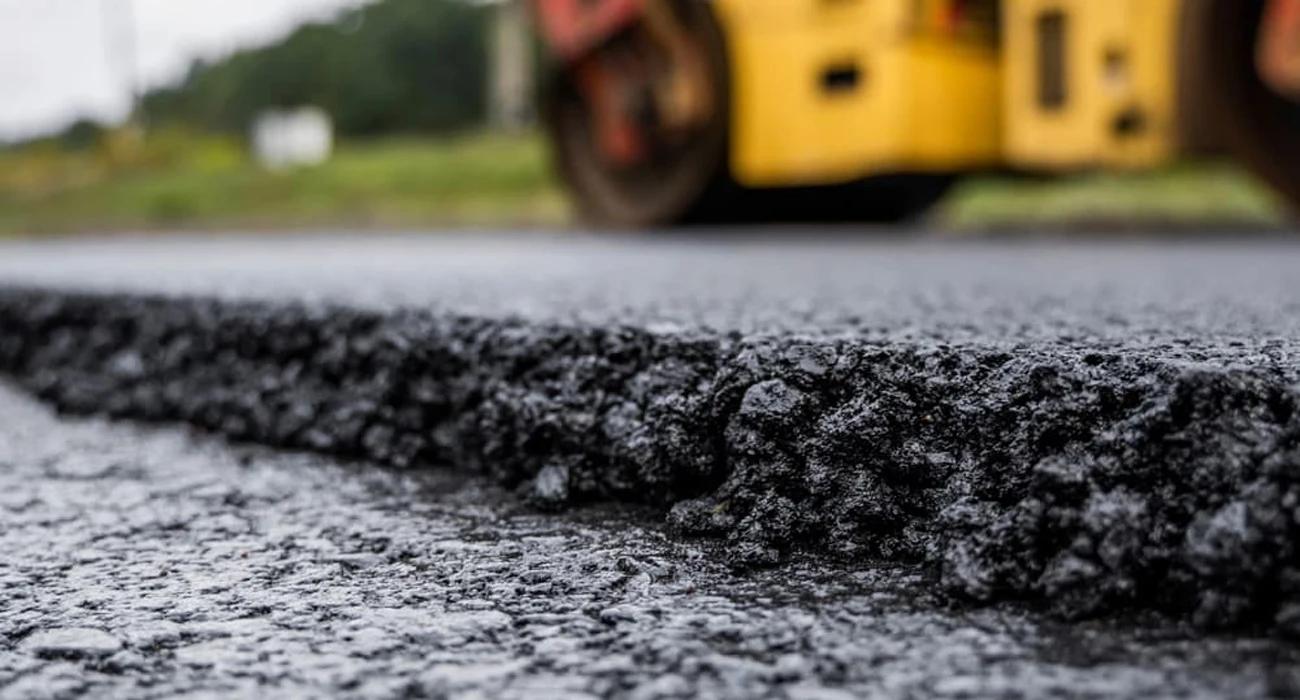
Requirements for a Reasonable Discharge Structure
| Uniform Discharge: | The discharge port must ensure smooth material release within the cavity, avoiding instantaneous concentration or localized material stagnation, thus maintaining a uniform mixture. |
| Controllable Discharge Rhythm: | The discharge port structure should be compatible with continuous production rhythms, ensuring stable discharge of each batch of mixture and facilitating continuous operation by the construction team. |
| Reduced Impact and Vibration: | The discharge port design should buffer the material drop, avoiding excessive impact on the cavity, blades, and bottom structure, while also reducing mixture splashing. |
| Adaptability to Different Aggregates and Proportions: | The structure must adapt to different aggregate sizes and asphalt content, ensuring smooth discharge of mixtures with different proportions. |
| Ease of Maintenance and Cleaning: | The discharge port design should facilitate the cleaning of residues, reducing the risk of blockage and maintaining long-term operational stability. |
Potential Consequences of an Inappropriate Discharge Structure
| Localized Material Stagnation: | An excessively small or steep discharge port may cause mixture accumulation at the bottom of the cavity, affecting uniformity. |
| Discharge Fluctuations: | Uneven discharge can lead to unstable material receiving by the construction team, making it difficult to guarantee construction quality. |
| Excessive impact: | The concentrated, instantaneous drop of material accelerates wear on blades and the cavity, increasing maintenance frequency. |
| Decreased construction efficiency: | Uneven material discharge leads to downtime or operational delays, impacting the overall project progress. |
Although the discharge structure may seem simple, it directly affects the uniformity of the mixture, the discharge rhythm, and the construction efficiency. A well-designed discharge port can ensure smooth, stable, and controllable material flow, avoiding material stagnation, fluctuations, and impacts, thus providing a reliable guarantee for high-yield continuous production.
Macroad’s Comprehensive Optimization of the Mixing System
As a professional asphalt plant supplier, Macroad understands the core role of the mixing system. High-quality mixtures depend not only on individual components but also on the coordinated work of the mixing shaft, blades, chamber, and discharge structure. To ensure high output, continuous production, and stable discharge, Macroad has optimized every aspect of the system, making the mixing unit more reliable in actual construction.
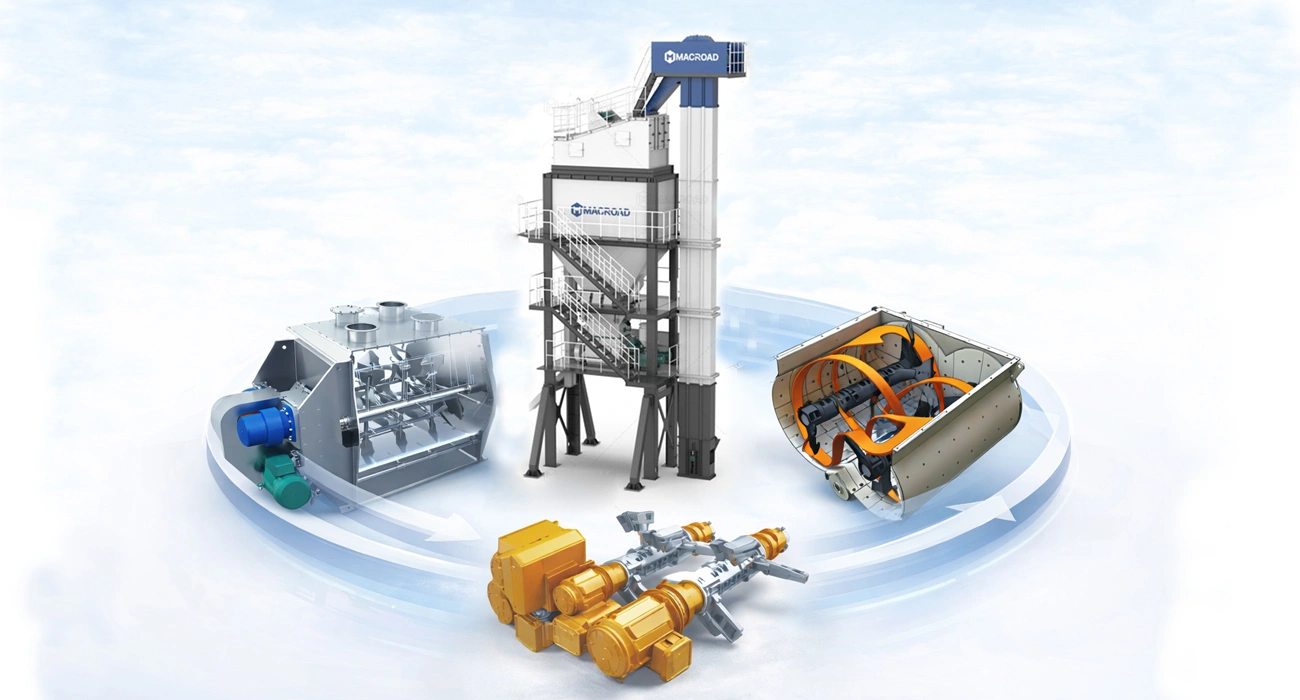
Optimization Measures for the Agitator Shaft
- Dual-shaft shear optimization reduces discharge fluctuation by 10%: Macroad optimizes the relative angle and speed ratio of the two shafts, resulting in more balanced longitudinal tumbling and lateral cross-flow. Under actual production conditions, this design can increase material circulation participation by approximately 10%, improve mixing uniformity by approximately 5%, and reduce local stagnation in the chamber, especially reducing discharge fluctuation by approximately 10% in high-volume continuous production environments.
- High-strength alloy material enhances shaft rigidity: Reinforced design is added to key stress areas, and high-strength alloy materials are used to maintain structural stability of the shaft under long-term high-load operation. Compared to conventional structures, shaft offset during operation can be reduced by approximately 20%, resulting in a more stable mixing trajectory and reducing mixing unevenness caused by structural micro-deformation.
- Energy efficiency improved by approximately 8%–12%: By accurately calculating the load characteristics of dual shafts and optimizing power matching, mixing efficiency per unit time is improved by approximately 8%–12%, while reducing power fluctuation amplitude. Overall energy consumption can be reduced by approximately 5%–10%, with more significant energy-saving effects in continuous production conditions.
Optimization Measures for Mixing Blades
- Optimized Blade Layout: Adjusting the blade tilt angle and staggered layout creates a three-dimensional tumbling and convection circulation of material within the chamber. This design can increase effective circulation participation by approximately 10%–15%, significantly reduce dead zones within the chamber, and improve mixing uniformity by approximately 5%–8%.
- Optimized Blade Shear Frequency: Precisely controlling the blade spacing and staggered angle reduces operating resistance while ensuring shear strength. For high-viscosity asphalt mixtures, this can increase fusion efficiency by approximately 8%–12% and reduce mixing time by approximately 5%.
- Upgraded Wear-Resistant Materials and Quick Maintenance: Utilizing high-strength wear-resistant alloy materials and a modular installation structure. Compared to conventional structures, blade lifespan can be extended by approximately 20%, and downtime for single maintenance can be reduced by approximately 20%.
Optimization Measures for Mixing Chamber Structure
- Optimized Internal Flow Guidance to Improve Mixing Efficiency: By adding guide plates or auxiliary guiding structures, the material circulation path is made more balanced. Optimized chamber design reduces localized material stagnation by approximately 15%–20%, improving overall mixing efficiency by approximately 5%–10%.
- Structural rigidity and temperature balance design, reducing temperature fluctuations: Strengthening key stress areas and optimizing the insulation structure ensures geometric stability of the chamber under high-temperature and high-load conditions. Long-term structural deformation tendencies can be reduced by approximately 15%, and the temperature fluctuation range of the mixed material outlet can be reduced by approximately 3%.
- Improved discharge transition: Optimizing the bottom discharge transition curve and angle results in smoother material release. Under continuous production conditions, discharge rhythm fluctuations can be reduced by approximately 10%–15%, while also reducing impact wear on the bottom structure.
Discharge structure optimization measures
- Uniform discharge design: Optimizing the outlet size and angle ensures smooth material flow and reduces localized stagnation. Optimized discharge continuity can be improved by approximately 10%, and localized residual material is significantly reduced.
- Buffering and rhythm control: Adding buffering and guiding structures to the discharge path ensures smooth material release. This design reduces instantaneous impact load by approximately 15% while improving the consistency of continuous production rhythm.
- Adaptable to different aggregates and mix proportions: The discharge structure is adaptively designed for aggregates of different particle sizes and asphalt contents. Under multiple mix proportion conditions, the rate of material blockage can be reduced by approximately 15%–20%, and downtime due to cleaning is reduced.
By systematically upgrading the mixing shaft, blades, chamber, and discharge structure, Macroad’s mixing units maintain uniform mixes, stable output, and controllable construction rhythm during high-volume continuous production. These optimizations aim to provide you with a smoother and more reliable user experience, ensuring that every batch of mix easily meets construction requirements.
As the core of an asphalt mixing plant, the mixing unit not only bears the weight of every step of the mixing process but also directly determines the uniformity and discharge stability of the mixture. From the movement of the mixing shaft to the tumbling and shearing of the blades, and the circulation path of the chamber and the rhythm control of the discharge port, every detail affects the final construction effect. Through reasonable structural design and optimization, the mixing system can maintain stability and efficiency in high-volume continuous production, providing reliable support for road construction and ensuring that each batch of mixture is more uniform and easier to construct, achieving a dual improvement in efficiency and quality.