

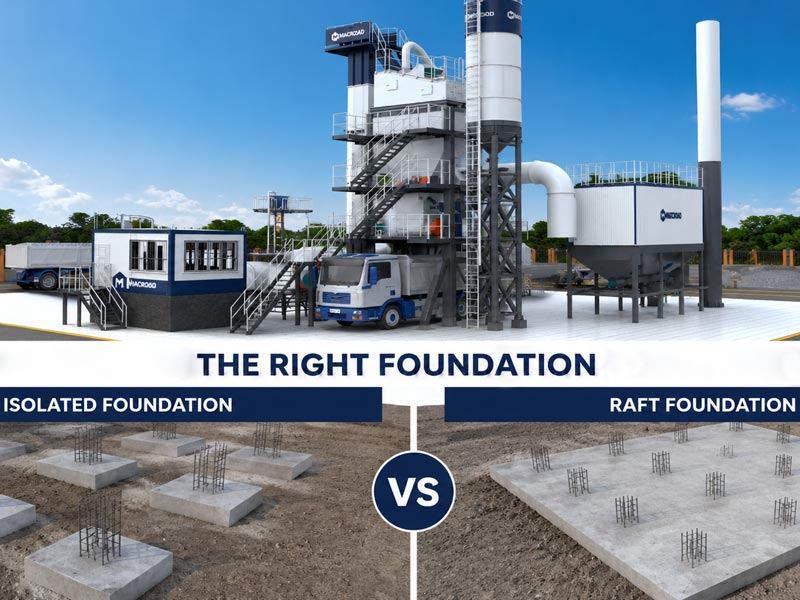
If you are planning a new asphalt mixing plant, determining the appropriate foundation design in advance facilitates smoother equipment installation, ensures precise pipeline connections, and minimizes future maintenance issues.
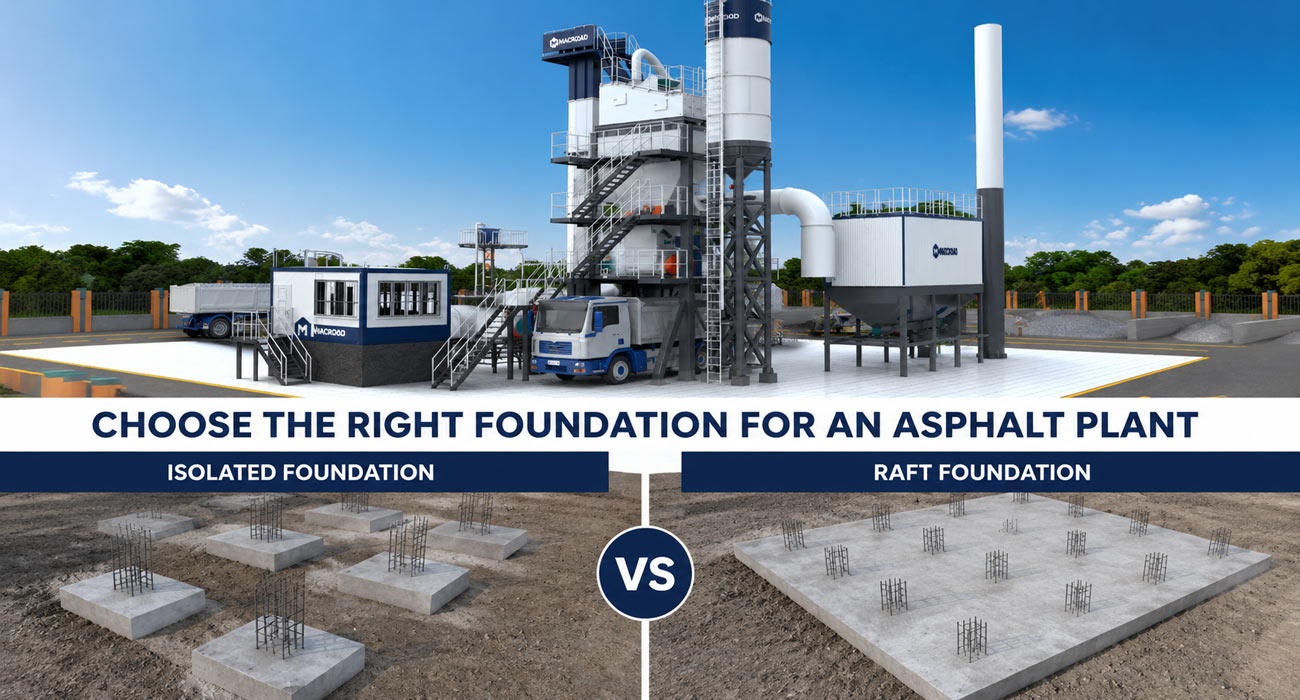
A solid foundation maintains the mixing tower’s level over the long term and minimizes stress on asphalt and thermal oil pipelines during operation, thereby ensuring system stability. Carefully planning the foundation at the initial stage establishes a reliable basis for subsequent equipment installation, pipeline commissioning, and startup, making the entire plant construction process easier to manage and control.
What to Consider When Planning an Asphalt Plant Foundation
Understanding the factors that directly impact the long-term, stable operation of your asphalt plant during the planning phase of equipment foundation allows you to make decisions with greater ease and confidence. Each consideration acts as a safety cushion, ensuring that the main mixing unit, drying drum, and finished product silo operate on a stable base, thereby minimizing future adjustment and maintenance issues.
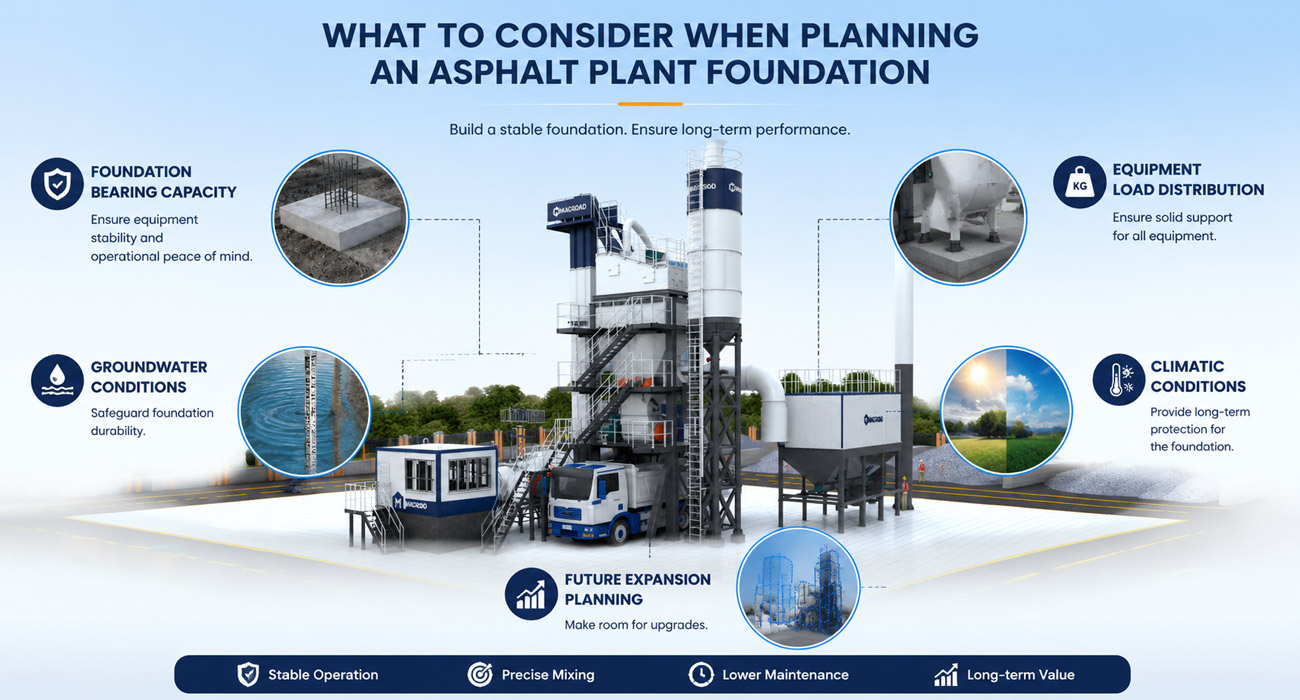
Next, we will analyze the key factors involved in selecting a foundation step-by-step, providing you with a deeper understanding of the process.
Foundation Bearing Capacity — Ensuring equipment stability and operational peace of mind
A foundation capable of supporting the equipment’s weight keeps heavy machinery—such as mixing towers and drying drums—level, minimizes vibration and shifting, and ensures consistent mixing precision over the long term.
Key considerations:
- Soil bearing capacity: Confirm through geological surveys that the soil can withstand the concentrated loads of the equipment.
- Soil uniformity: Uneven bearing capacity across the site can cause slight settling, affecting pipeline joint stress and mixing quality.
- Settlement prediction: Assess potential future settlement and incorporate appropriate margins into the foundation design to ensure long-term stability and levelness.
Groundwater Conditions — Safeguarding foundation durability
Properly accounting for groundwater levels and drainage ensures the long-term stability of the concrete foundation, minimizes pipeline corrosion and structural damage, and maintains precise equipment connections over time.
Key considerations:
- Groundwater level: High water levels may lead to prolonged submersion of the foundation, necessitating waterproofing or drainage measures.
- Drainage design: Install drainage ditches or wells to keep the area around the foundation dry and minimize concrete expansion caused by water absorption.
- Soil moisture fluctuations: In areas with seasonal rains or heavy precipitation, changes in soil moisture can cause slight settlement; this requires advance assessment.
Equipment Load Distribution — Ensuring solid support for all equipment
Precisely matching the foundation’s bearing capacity ensures that all equipment support points are firmly seated, reduces installation and adjustment time, and maintains the alignment of pipelines and transmission systems.
Key considerations:
- Equipment weight: Consider the individual point weights and dynamic loads of the main mixer, drying drum, and finished product silos.
- Support leg distribution: The spacing, positioning, and load concentration of equipment support legs determine the feasibility of using isolated footings versus a raft foundation.
- Future expansion: Account for potential additions, such as cold feed bins or storage tanks, by reserving extra load capacity in the foundation design.
Climatic Conditions — Providing long-term protection for the foundation
Adapting to the local climate ensures foundation stability amidst high temperatures, rainy seasons, or frozen ground, preventing equipment tilting or abnormal stress on pipeline joints due to environmental changes.
Key considerations:
- Freeze-thaw cycles: In cold regions, the foundation design must account for frost heave.
- High-Temperature Thermal Expansion: High summer temperatures may cause slight expansion in the concrete; the design incorporates allowances for thermal expansion.
- Rainfall and Drainage: Accumulation of surface water during the rainy season can affect soil moisture levels around the foundation; drainage planning is required.
Future Expansion Planning — Making Room for Upgrades
Incorporating design margins into the foundation allows for the future addition of equipment or increased production capacity without modifying the existing foundation, resulting in a faster and more cost-effective expansion process.
Specific Considerations:
- Equipment Additions: Consider the potential addition of cold feed bins, asphalt storage tanks, etc.
- Layout Adjustments: Reserve sufficient space for future modifications or expansions.
- Load-Bearing Capacity: Account for potential increases in future loads during the foundation design phase to ensure long-term stability.
Understanding soil conditions, hydrological factors, equipment loads, and environmental characteristics is not merely a technical exercise; it is about ensuring that every foundation securely supports the equipment, facilitating smoother construction and providing peace of mind for future operation. Mastering the key principles of foundation selection will enable you to more easily determine which type of foundation is best suited to your project.
Isolated Foundations: The Preferred Option for Asphalt Plants
With the preceding information regarding the key factors influencing foundation selection, the next step becomes clear: understanding the structural characteristics and applications of the various foundation types themselves.
For asphalt mixing plant projects, the isolated foundation is the most common type and is often the preferred solution for many standard projects.
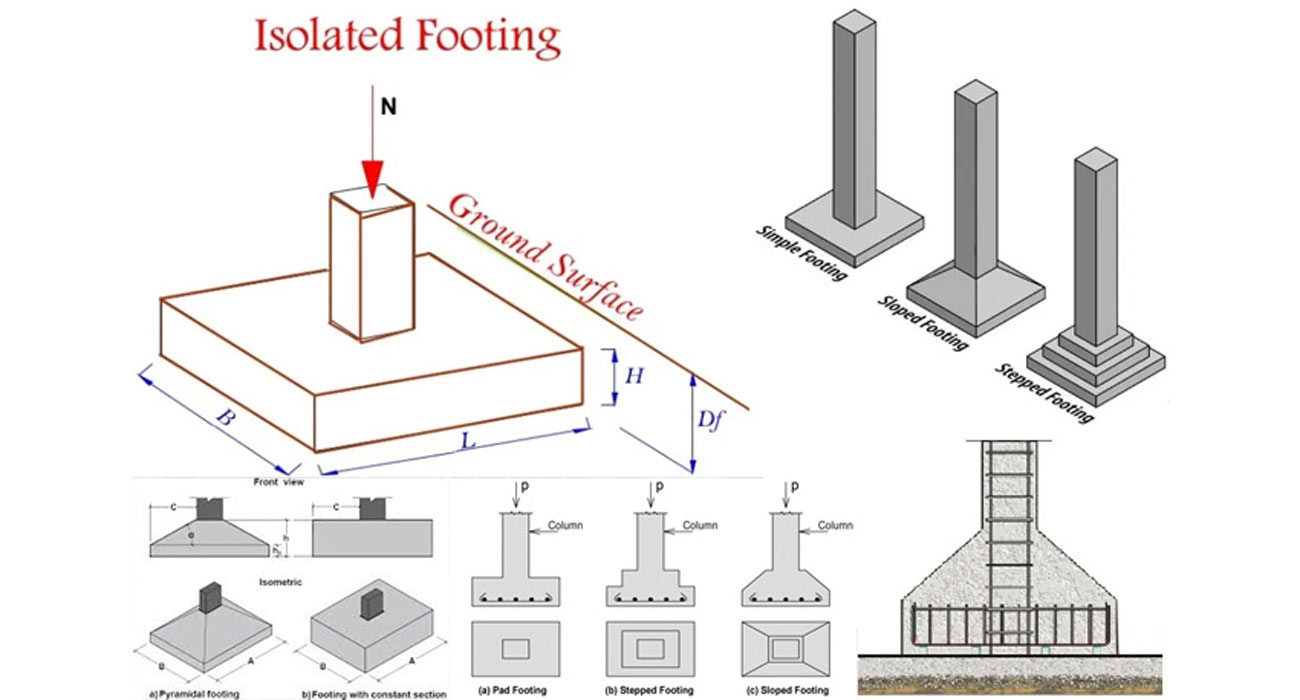
An isolated foundation is a type where each equipment column base rests on its own independent load-bearing block. By allowing each foundation to independently support the load of its corresponding column base, this method ensures clear and stable load distribution while offering construction flexibility and efficient material usage. In the construction of asphalt mixing plants, this foundation type is frequently the top choice because it allows for designs tailored to the specific loads of individual column bases. Its key characteristics include:
Independent load-bearing
Each column base has its own footing; there are no structural connections between adjacent foundations, so loads do not interfere with one another.
Customizable dimensions
The base plate dimensions and embedment depth for each column position can be optimized based on the specific load; foundations for columns bearing heavier loads are larger, while those for lighter loads are smaller.
Compact construction volume and distinct procedures
Each foundation pit is independent. The construction process—comprising layout and surveying, excavation, pouring the bedding layer, rebar tying, formwork installation, and concrete pouring—can be completed in batches.
Concrete placement limited to necessary areas
Foundations cover only the area beneath the column bases, eliminating the need for continuous concrete pouring between foundations and reducing the workload in non-load-bearing areas.
Broad adaptability to site conditions
On sites with good soil bearing capacity, uniform soil layers, and a low water table, isolated foundations can stably support the equipment without requiring additional ground improvement.
Clear support points and flexible layout
As each support point is independent, foundation locations can be flexibly arranged to suit the mixing tower layout and equipment configuration, accommodating various combinations of equipment models and sizes.
Why Do Asphalt Plants Commonly Use Isolated Foundations?
In asphalt mixing plant projects, the choice of foundation type often requires striking a balance between construction costs, scheduling, and geological suitability. Isolated footings are widely adopted in many standard projects primarily because they offer clear and controllable engineering performance during actual implementation.
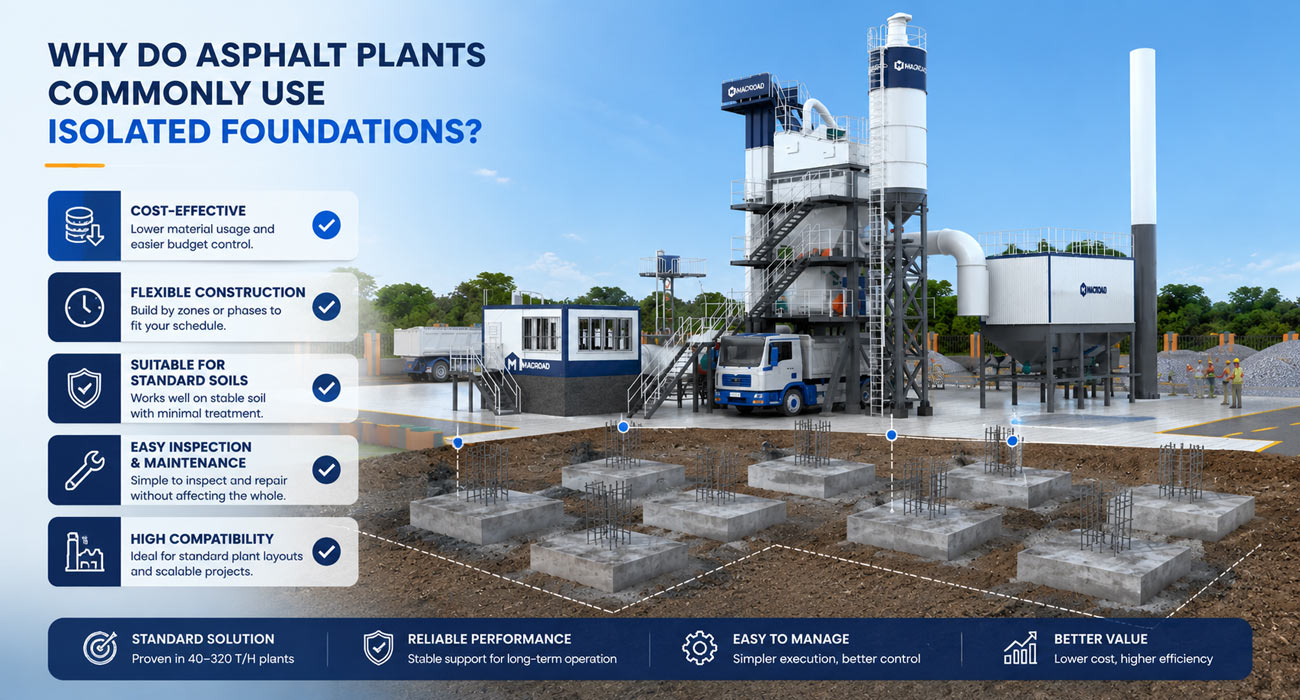
Concentrated construction investment facilitates overall cost control
In project budget planning, isolated footings are generally easier to break down and estimate.
- Concrete usage is concentrated primarily in the column base load-bearing areas.
- No large-scale monolithic structural pouring is required.
- Rebar quantities are calculated individually for each footing.
For asphalt mixing plant projects of similar scale, this structural form allows civil engineering investments to be tracked and managed on a modular basis.
Flexible construction pacing adapts to various schedules
The construction method for isolated footings relies on point-by-point progression, offering high flexibility in actual projects.
- Footings can be constructed simultaneously in zones or in phases.
- Work does not depend on the completion of the entire structure before proceeding to the next stage.
- Construction resources can be allocated by zone.
This approach simplifies the organization of on-site workflows, particularly for projects with tight schedules or limited construction crews.
High suitability for standard geological conditions
Soil conditions are typically stable on most industrial sites.
- Soil layers with medium or higher load-bearing capacity can be utilized directly.
- Minimal foundation treatment is usually required.
- Low dependency on groundwater conditions.
Under these site conditions, isolated footings provide a straightforward method for constructing equipment support structures.
Clearer pathways for inspection and maintenance
During long-term operation, the foundation structure exhibits distinct modular characteristics.
- Each column base corresponds to an isolated footing/pile cap.
- Inspections and assessments can be conducted on a point-by-point basis.
- Localized repairs do not affect the overall structure.
This structural design facilitates point-by-point status verification during long-term equipment operation or routine maintenance.
High compatibility with standardized mixing plant configurations
Isolated footings are widely used in engineering practice for common asphalt mixing plant specifications (e.g., 40–320 t/h capacity).
- Equipment load distribution patterns are relatively clear.
- Column base layouts are standardized.
- It facilitates the creation of replicable construction plans.
Consequently, this foundation type allows for the development of mature construction best practices across numerous standard projects.
In engineering practice, the advantages of isolated footing lie primarily in the flexibility of construction organization, the clarity of cost structures, and their excellent suitability for standard site conditions. Rather than a complex design, it is a foundation solution that leans towards standardization and ease of implementation.
Isolated Foundation Construction: A Complete Step-by-Step Guide
Now that you understand the characteristics and project advantages of isolated foundations, it is time to put theory into practice. During the construction process, every step—from site layout and marking to concrete pouring—directly impacts the stability and long-term performance of your equipment.
Below, I will walk you through the step-by-step construction process for isolated foundations, ensuring the workflow is clear and manageable for smooth on-site execution.
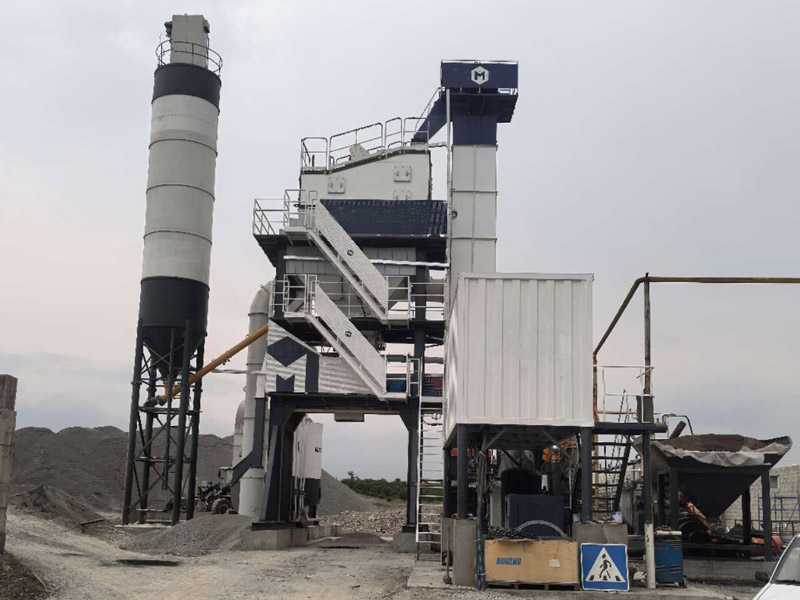
Site Survey and Layout
- Determine column base locations: Precisely mark the position of each column base according to the mixing plant design drawings.
- Establish elevation benchmarks: Confirm the overall foundation level to ensure all column bases lie on the same horizontal plane.
- Layout verification: Cross-check layout lines multiple times to ensure the foundation arrangement is accurate.
Excavation
- Individual pit excavation: Determine excavation depth based on design specifications and soil conditions.
- Slope maintenance or shoring: Ensure pit edges are stable to prevent collapse.
- Sectional construction: Excavate multiple foundations simultaneously to avoid occupying the entire site at once.
Foundation Cushion Construction
- Laying the cushion layer: Use sand and gravel to ensure uniform load distribution on the pile caps and minimize settlement.
- Compaction: Compact the layer (mechanically or manually) to ensure density and stable load-bearing capacity.
- Thickness control: Adhere to design specifications for cushion thickness to ensure accurate subsequent pile cap dimensions.
Rebar Installation
- Rebar layout: Install reinforcement for the pile cap base and column bases strictly according to design drawings.
- Joint inspection: Verify that rebar spacing, lap lengths, and concrete cover thickness meet standards.
- Embedded items: Secure items such as anchor bolts and pipe sleeves in advance, in accordance with equipment installation requirements.
Formwork Erection
- Pile cap formwork setup: Securely support formwork to prevent deformation during concrete pouring.
- Reinforcement check: Ensure formwork is braced to prevent shifting or tilting during pouring.
- Dimensional accuracy: Ensure formwork dimensions are precise, as they directly determine the pile cap’s plan dimensions and height.
Concrete Pouring and Vibration
- Sectional pouring: Pour concrete in sequence or batches to avoid large-scale, simultaneous pouring.
- Vibration for compaction: Vibrate thoroughly to eliminate honeycombing or air pockets, ensuring full load-bearing capacity.
- Surface leveling and curing: Level the surface promptly after pouring and initiate early-stage curing to prevent cracking.
Foundation Inspection and Post-processing
- Dimensional and elevation verification: Confirm that all pile caps meet design requirements for levelness and dimensions.
- Quality inspection: Check concrete cover thickness, concrete strength, and surface quality.
- Marking and Numbering: Each foundation is individually numbered to facilitate subsequent equipment installation and maintenance.
The construction process for isolated foundations is clear and controllable; every step—from site surveying and excavation to rebar tying, formwork erection, and concrete pouring—is executed in strict accordance with the design. The approach of phased construction and zoned pouring not only accommodates varying site conditions but also provides a stable, reliable foundation for asphalt hot mix plant installation.
An Alternative for Special Ground Conditions: Raft Foundations
For most asphalt mixing plant projects, isolated footings are sufficient to meet operational requirements under standard geological conditions. However, when dealing with sites characterized by low soil bearing capacity, uneven soil distribution, or complex groundwater conditions, the approach to foundation design must be adjusted. In such cases, a foundation type offering greater structural integrity—the raft foundation—is typically employed.
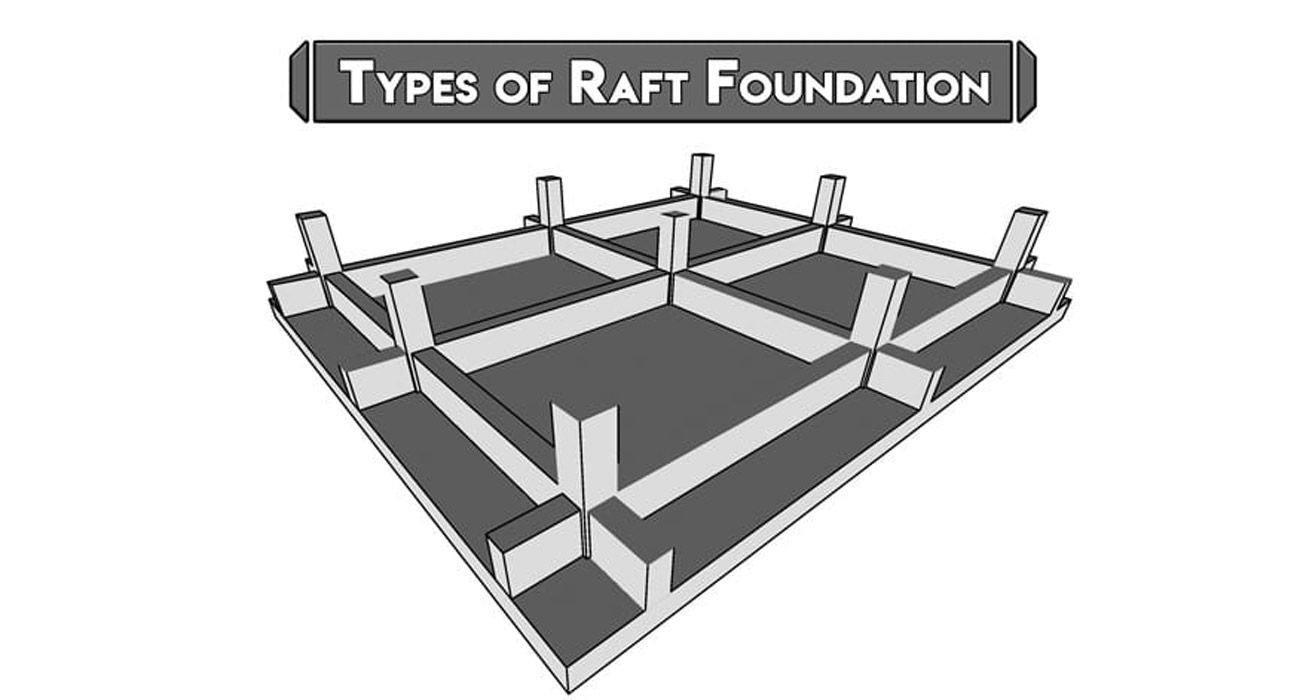
A raft foundation is designed to support the entire equipment area as a single, unified structure. By utilizing a large reinforced concrete slab, it distributes the load from the superstructure evenly across a wider area of the subgrade, thereby minimizing localized stress concentrations. Specifically, the key characteristics of this type of foundation include:
Integrated Load-Bearing: Uniform Load Distribution
- Continuous Base Slab Structure: The raft foundation integrates the base slab across the entire equipment area, allowing loads from all equipment to be transferred collectively to the subgrade.
- Load Dispersion: The weight of the superstructure is not concentrated on individual column bases but distributed over a large foundation surface area, thereby reducing localized subgrade pressure.
- Minimized Stress Concentration: Prevents settlement or localized cracking caused by single-point overloading and enhances the overall stability of the foundation.
Resistance to Differential Settlement
- High Overall Rigidity: The continuity of the raft foundation synchronizes settlement across different zones, reducing the risk of equipment tilting due to localized settlement.
- Adaptability to Weak Soil Layers: Even where local soil bearing capacity is low, the monolithic slab disperses the load, ensuring the equipment remains level and stable.
- Mitigated Long-Term Settlement Effects: Overall settlement is more controllable during long-term operation, simplifying maintenance requirements.
High Rigidity and Structural Integrity
- Massive Reinforced Concrete Structure: The thickness of the base slab and the reinforcement layout enhance overall rigidity, providing superior load-bearing capacity.
- Collaborative Load-Bearing: Support points do not act independently but work together within the monolithic structure to enhance stability.
- Enhanced Deformation Resistance: High overall rigidity ensures the equipment is less susceptible to the effects of vibration or localized loads during operation.
Strong Subgrade Adaptability
- Suitable for Low-Bearing-Capacity Soils: When subgrade bearing capacity is insufficient, the base slab disperses the load over a larger area, increasing the safety margin.
- Adaptable to Sites with High Groundwater Levels: The continuous base slab mitigates the impact of localized water seepage, ensuring structural stability remains unaffected by water level fluctuations.
- Tolerance of Soil Heterogeneity: On sites with significant variations in soil thickness or bearing capacity, the monolithic slab balances the load and minimizes differential settlement.
High Requirements for Construction Continuity
- Large-Scale Excavation and Formwork: Construction covers the entire equipment area, requiring a relatively concentrated approach to construction organization.
- Monolithic Pouring Process: Concrete must be poured in a single operation or in continuous sections to ensure the integrity and uniformity of the base slab.
- Strict construction sequencing: Rebar tying, formwork installation, and concrete vibration must be carried out in the prescribed order; failure to do so may compromise the overall load-bearing performance.
Suitable for high loads or complex equipment layouts
- Concentrated loads (e.g., hot aggregate bins or mixing pans): The base slab effectively distributes localized high-pressure loads, ensuring equipment safety.
- Multi-equipment zones: Large mixing plants feature densely packed equipment; a raft foundation can manage loads from multiple points, ensuring balanced support.
- Supports future expansion: The monolithic slab structure allows for load redistribution when undertaking localized reinforcement or installing additional equipment on the existing base.
The characteristics of raft foundations can be summarized as follows: integral load-bearing capacity, settlement resistance, high rigidity, strong adaptability to ground conditions, high construction continuity, suitability for heavy loads and complex layouts, and predictable long-term performance.
For you, this means:
- On sites with weak or complex geological conditions, you need not worry about localized settlement affecting equipment operation;
- Heavy or densely arranged mixing equipment receives stable support, thereby reducing safety risks;
- The integrated construction plan allows for advance scheduling, making project costs, timelines, and long-term maintenance more manageable.
By understanding the characteristics of raft foundations, you can more accurately determine when to adopt this solution, laying a solid foundation for your project.
Isolated vs Raft Foundations: Choosing the Right Solution for Your Project
Having understood the structural characteristics of isolated footings and raft foundations, you might be wondering: which type is better suited to your project?
In reality, there is no single correct answer; the choice requires a comprehensive assessment based on factors such as geological conditions, equipment loads, and construction scheduling. To facilitate a clear comparison, we have evaluated both foundation types across several key dimensions, making the differences easier to understand.
| Isolated Foundation | Comparison Dimension | Raft Foundation |
| Each column has an isolated footing, bearing load individually | Structural Form | Continuous reinforced concrete slab, bearing load as a whole |
| Loads are transferred to local ground areas at each column | Load Transfer Method | Loads are evenly distributed through the entire foundation slab |
| Medium or higher bearing capacity, relatively uniform soil layers | Suitable Ground Conditions | Low bearing capacity or uneven soil layers |
| Sensitive to local settlement; requires good ground conditions | Settlement Resistance | Strong overall integrity; can accommodate uneven settlement |
| Relatively low; concentrated at column positions | Concrete Usage | Higher; covers the entire equipment foundation area |
| Point-by-point construction; can be done in phases | Construction Method | Continuous construction; requires concentrated and coordinated work |
| Relatively short; flexible organization | Construction Duration | Relatively long; requires continuous workflow |
| Lower; easy to manage in sections | Construction Complexity | Higher; requires coordination of large areas |
| Conventional asphalt plants (small to large) | Applicable Equipment Type | Large-scale or high-load, densely equipped asphalt plants |
| Usually requires relatively good ground conditions | Ground Preparation Requirement | More suitable when ground improvement is needed |
| Clear single-point maintenance; convenient for local adjustments | Maintenance & Adjustment | Primarily overall structure; requires holistic assessment |
| Lower material usage; cost is concentrated and controllable | Cost Structure | Higher material usage; overall investment is greater |
The comparison reveals that neither foundation type is inherently superior; rather, each is suited to different engineering conditions and project requirements. For most standard geological conditions and typical asphalt mixing plant projects, isolated footings are the more common choice, whereas raft foundations are generally employed in cases involving challenging geological conditions or heavy loads.
This comparison enables you to more clearly determine the appropriate foundation type based on the specific conditions of your project.
FAQs
Why do most asphalt mixing plant projects opt for isolated footings?
Under standard geological conditions, isolated footings effectively meet the equipment’s load-bearing requirements, making them the most common choice for standard asphalt mixing plant projects.They are designed to support individual column bases; where soil layers are uniform and possess adequate bearing capacity, the footings can be laid out directly without the need for a large, monolithic structural slab.
Can isolated footings still be used if there are localized areas of weak soil?
Yes, isolated footings can still be used in areas with localized weak soil, though this usually requires supplementary ground improvement measures, such as:
- Localized soil replacement (removing weak soil layers)
- Tamping or compaction (to increase bearing capacity)
- Enlarging the footing size (to distribute the load)
The specific approach is usually determined based on the results of the site investigation.
What requires special attention during the construction of isolated footings?
Precision in positioning and elevation control are critical during construction.Since each column base rests on an isolated footing, the following must be carefully managed:
- Alignment of axes between footings
- Uniformity of elevations after concrete pouring
- Positional accuracy of embedded anchor bolts
These details directly impact the ease of subsequent equipment installation.
How do maintenance requirements differ between isolated footings and raft foundations?
Are isolated foundations suitable for large-scale asphalt mixing plants?
Yes, they are suitable.In many large-scale asphalt mixing plant projects, isolated foundations remain a common solution, provided that geological conditions meet the requirements.
The key factor is whether the load from each equipment support leg can be borne by the isolated foundation within the design limits.
What are the basic requirements for soil bearing capacity when using isolated footings?
Generally, isolated footings are suitable for sites with relatively stable bearing capacity—typically where the characteristic value of the soil bearing capacity is 150 kPa or higher.Additionally, if the soil distribution is uniform, it is easier to keep foundation settlement within the design limits.
Under what circumstances might a raft foundation be considered?
Raft foundations are more likely to be adopted in the following scenarios:
- Low soil bearing capacity or thick layers of soft soil
- High groundwater levels with significant fluctuations
- Significant risk of differential settlement
Under these conditions, the raft foundation distributes loads more evenly by acting as a single, unified structural unit.
Macroad’s Expert Support in Foundation Construction
As a professional asphalt plant supplier, Macroad not only provides high-quality equipment but also fully recognizes the critical importance of the foundation. During the foundation construction phase, Macroad offers comprehensive technical support and engineering guidance to ensure the successful construction of isolated or raft foundations, thereby establishing a solid base for the entire project from the very start.
Foundation Design Consultation
- Provide recommendations on selecting either isolated footings or raft foundations based on equipment specifications and site conditions.
- Optimize foundation dimensions and reinforcement layouts tailored to specific column base loads and soil profiles.
- Supply construction drawings and design parameters to ensure foundations meet equipment installation requirements.
Construction Plan Guidance
- Outline construction workflows, covering stages such as excavation, bedding layer installation, rebar tying, and concrete pouring.
- Assist with on-site construction organization and scheduling (phased or centralized) to optimize the project timeline.
- Highlight key construction points and precautions to ensure quality and safety.
Technical Training and On-site Support
- Conduct professional training for on-site construction teams, focusing on critical aspects of foundation construction.
- Provide on-site technical support to address issues encountered during construction.
- Assist with quality inspections to ensure every foundation meets design standards.
Foundation Suitability Optimization
- Propose recommendations for localized soil treatment or reinforcement based on actual geological survey reports.
- Assist in evaluating soil bearing capacity to ensure long-term equipment stability.
- Provide feasible foundation solutions (raft or isolated footings) for challenging geological conditions.
Long-term Operational Guidance
- Offer recommendations for foundation maintenance and monitoring.
- Provide guidance on the periodic inspection of foundation conditions and anchor bolts.
- Assist clients in establishing long-term operational records to ensure safe, sustained equipment performance.
Macroad is more than just an equipment supplier; we are your professional consultant throughout the plant construction process. Whether for isolated footings or raft foundations, Macroad provides comprehensive support—spanning design, construction, and long-term operation—to ensure your asphalt mixing plant project is rock-solid and reliable right from the foundation up.
By selecting the right foundation type and leveraging Macroad’s professional expertise, your asphalt mixing plant can operate efficiently on a stable foundation, delivering long-term value and ensuring operational safety.