

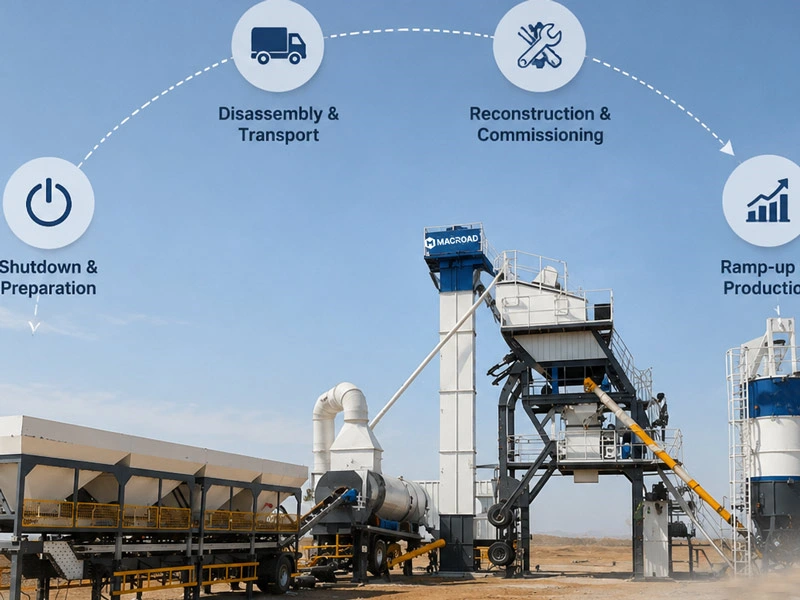
At a construction site, relocating a mobile asphalt mixing plant may appear to be a simple process involving nothing more than disassembly, transport, and reassembly. In reality, however, every site transfer entails a complex web of hidden, multi-layered costs—ranging from material wastage during the production shutdown phase to labor hours for disassembly and equipment inspections, the inherent uncertainties of the transport stage, and finally, the installation, commissioning, and production ramp-up at the destination site.
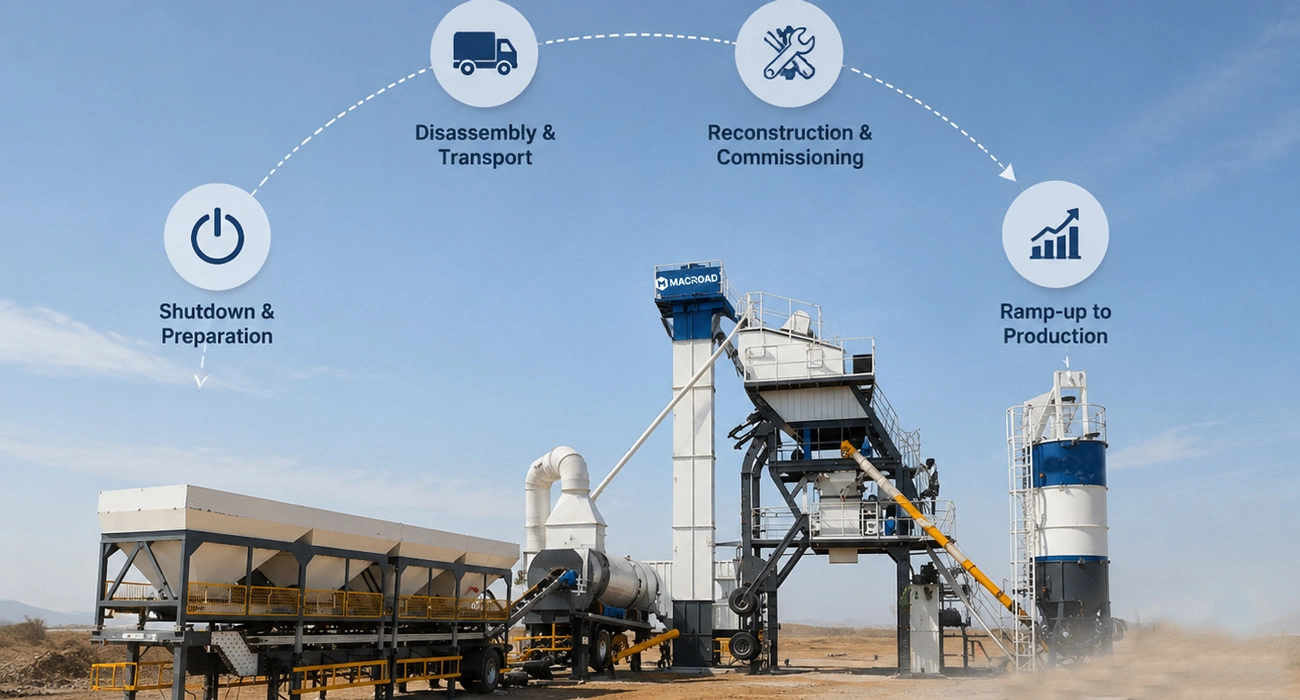
Formulating a budget for such a transfer is no easy task, as the expenses associated with many of these stages are difficult to fully estimate in advance. If you are currently planning a site transfer, we hope this article will serve as a useful reference to assist you in your budgeting and decision-making processes.
Phase 1: Shutdown Preparation Costs
When planning the relocation of a mobile asphalt mixing plant, many project teams tend to focus their attention primarily on the actual day of equipment dismantling. In reality, however, the accumulation of costs typically begins the moment the decision to halt production is made.
For a job site currently engaged in continuous material supply, suspending operations involves far more than simply pressing a pause button. Production cycles must be wound down, on-site materials organized, and equipment status verified; furthermore, personnel and construction schedules may require adjustment.
These steps—which appear to be mere preparatory phases—often gradually translate into tangible financial expenditures. It is worth noting that many of the costs incurred during this stage rarely appear directly within the transportation contract itself, yet they undeniably impact the overall budget for the entire relocation project.
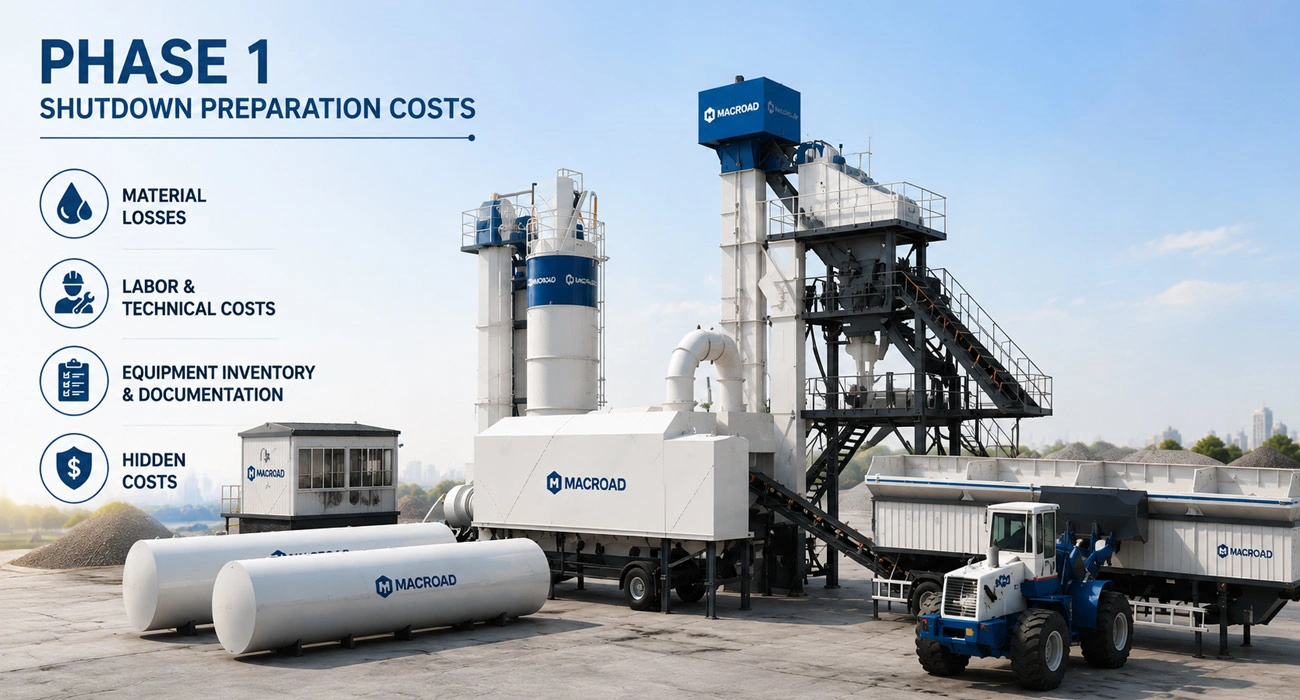
Material Losses During Production Wind-down
- Waste Loss from Final Batches: The final few batches produced prior to a shutdown often fail to reach a full production volume; consequently, the remaining mixed material typically must be discarded as waste. The volume of waste generated depends on the precision of the shutdown schedule—the more rushed the plan, the greater the loss.
- Costs for Emptying Asphalt Storage Tanks and Pipelines: Residual asphalt within storage tanks and transfer pipelines requires heating to be emptied, resulting in additional fuel consumption. Any asphalt residue that cannot be recovered must be treated as waste, which, in certain regions, entails specific compliance-related disposal fees.
- Impact of Season and Temperature: During winter or in low-temperature environments, asphalt solidifies more rapidly, making the emptying of pipelines significantly more difficult; this leads to corresponding increases in fuel consumption and labor hours. Conversely, in regions characterized by high temperatures and high humidity, issues related to asphalt volatilization and adhesion also exacerbate the difficulty of the cleaning process.
Labor and Technical Costs Associated with Dismantling
- The Ratio of Skilled to Unskilled Labor Directly Impacts Costs: Structures such as silos, dust collection systems, and electrical cabinets require the expertise of experienced, specialized technical workers to dismantle. The labor costs for this segment are substantially higher than those for general labor. Many projects, when budgeting, estimate the entire dismantling cost based solely on the unit rate for general labor, resulting in significant discrepancies when actual costs are settled.
- Cost Differences of Outsourcing vs. In-house Teams: Professional dismantling teams offer transparent pricing but come with a significant cost premium, and the coordination lead time can impact the schedule for site transitions. Conversely, while the costs of an in-house team are controllable, a lack of experience can lead to equipment damage during the dismantling process, ultimately resulting in even higher subsequent repair expenses.
- The Hidden Costs of Safety Risks: The dismantling phase represents the stage with the highest probability of accidents during an equipment relocation. Related insurance premiums and potential compensation costs for project delays should be itemized separately within the budget, rather than relying solely on the coverage provided by the main project contract.
Equipment Inventory and Condition Documentation
- Costs of Disputes Arising from Unclear Lines of Responsibility: If the condition of the equipment is not thoroughly documented prior to relocation, it becomes easy for disputes to arise regarding the attribution of liability. Resolving such disputes often proves to be more time-consuming and labor-intensive than the actual repair of the damage itself.
- Repair Costs Triggered by Undetected Issues at the New Site: If the wear-and-tear status of core components—such as drying drums, mixing tanks, or elevators—is not documented before the relocation, the cost of repairs will be significantly higher should these components subsequently fail after installation.
- Blind Spots in Insurance Coverage and Claims: Insurance payouts for transportation-related claims typically rely on documentation certifying the equipment’s condition prior to relocation; the absence of such records can directly jeopardize the outcome of a claim. In cases involving third-party leased equipment, a lack of condition documentation may result in the lessor attributing all incurred wear and tear—regardless of cause—to the lessee’s liability.
Viewed in isolation, none of the individual expenditures incurred during the asphalt production shutdown preparation phase appear particularly substantial. However, the quality of execution during this stage directly determines the cost risks associated with every subsequent phase: the more hastily materials are handled, the greater the loss; and the more cursory the disassembly assessment, the more disputes arise upon arrival at the destination. Accurately accounting for the costs of this phase therefore serves as the critical first line of defense in controlling the overall costs of the facility relocation.
Phase 2: Transportation Costs
Transportation costs are typically the only item explicitly itemized within a relocation budget. However, the true asphalt plant cost of the transport phase extends far beyond a mere freight invoice. Every step of the loading and unloading process carries the potential for additional expenses, and should any delays occur during the transport cycle, costs can ripple outward in a chain reaction.
Additional Costs of Oversize Transport
- Road Permits and Escort Requirements: The primary structural components of a concrete mixing plant—such as drying drums, structural frames, and silos—typically exceed standard limits for height and weight. Consequently, oversize transport permits must be applied for in advance. On certain road sections, the accompaniment of escort vehicles is mandatory throughout the entire journey; the costs associated with these escort services are generally not included in standard freight quotations.
- The Hidden Costs of Route Detours: Weight restrictions on bridges or height limitations within tunnels along the route often necessitate detours, thereby increasing both transport mileage and transit time. Furthermore, cross-border transport involves navigating varying oversize transport regulations across multiple nations; compliance requirements for each specific leg of the journey must be verified individually, and the associated coordination costs are frequently underestimated.

Step-by-Step Cost Breakdown of Loading and Unloading Operations
Step 1: Loading Preparation
- The departure site must feature sufficient paved or hardened ground capable of supporting hoisting equipment; if site conditions are substandard, steel plates or gravel bedding layers must be laid temporarily.
- Hoisting equipment—such as crawler cranes or truck cranes—must be booked in advance; during peak seasons when schedules are tight, waiting times can directly impact the overall project timeline and transition milestones.
Step 2: Hoisting Operations
- The hoisting of large structural components requires qualified, professional operators; labor costs for hoisting are billed on an hourly basis.
- Rain, snow, or muddy ground conditions can reduce hoisting efficiency; under adverse weather conditions, operating costs may increase by 20% to 40%.
- To mitigate the risks of equipment collision or accidental drops during hoisting, specialized hoisting insurance must be purchased separately; this cost is typically not covered under the scope of the main project insurance policy.
Step 3: Securing and Lashing
- Specialized lashing materials—such as chains, corner protectors, and waterproof tarpaulins—are typically quoted separately by the carrier and are frequently overlooked or omitted from the total project budget.
- In the event of transit damage caused by improper lashing, substantiating insurance claims can be difficult; consequently, the ultimate financial loss is often borne by the party responsible for the site relocation.
Step 4: Unloading and Positioning
- Unloading conditions at the destination site are often more complex than those at the departure site; factors such as the new site’s ground load-bearing capacity and the width of access roads may impose restrictions on the selection of appropriate hoisting equipment.
- If there is a significant distance between the unloading point and the final installation location, a secondary internal transfer (re-handling) will be required, incurring additional short-haul transport costs.
The Ripple Effect of Transportation Delays on Costs
A transportation delay is not merely an isolated cost point, but rather a triggering mechanism. Once the scheduled arrival of equipment is postponed, every subsequent project phase is forced to compress, resulting in a cascading accumulation of costs:
Transportation Delay → Delayed Equipment Arrival
Compressed Installation Window → Forced Expedited Work
Shortened Commissioning Period → Production Commences Before Equipment Meets Standards
Extended Production Ramp-up → Failure to Meet Material Supply Deadlines
Triggered Contractual Breach → Damages Far Exceed the Cost of the Delay Itself
Costs incurred during the transportation phase consist of two components: direct expenses arising from loading and unloading operations, and the cascading losses triggered by delays. The former can be controlled through meticulous, step-by-step budgeting; the latter, however—should it occur—often results in financial losses that exceed the entire cost of the transportation itself. Taken together, these two elements constitute the true financial cost of this phase.
Phase 3: Site Rebuilding Costs
With the equipment’s arrival at the new site, the relocation process has just entered a new phase. The reconstruction phase encompasses three distinct dimensions—foundation work, installation and commissioning, and supporting infrastructure—each requiring a dedicated allocation of resources. This phase is characterized by a high degree of uncertainty; the actual conditions at the new site frequently deviate from expectations, and every such deviation translates directly into additional time and costs.

Foundation and Substructure Engineering
Foundation engineering is one of the most challenging aspects of the asphalt plant reconstruction phase to accurately estimate in advance. Geological conditions, load-bearing requirements, and local construction standards vary significantly across new sites; any single variable has the potential to drive up the original budget.
- Geological Survey Costs: Prior to formal construction, a geological assessment of the new site is required to verify whether the soil’s load-bearing capacity meets the requirements for equipment installation. Survey costs vary significantly depending on the region and the size of the site.
- Variations in Foundation Pouring Standards: Different countries and regions have distinct regulatory requirements for the construction of industrial equipment foundations. Some regions mandate specific concrete grades and depth specifications, which directly impact material and construction costs.
- Costs for Addressing Unforeseen Geological Conditions: Subsurface obstructions (such as old foundations, rock strata, or groundwater) that were not detected during the survey phase may only be exposed during construction. The costs associated with resolving these issues are difficult to estimate and cannot be avoided in advance.
- Long-Term Impact of Foundation Quality on Equipment: An uneven foundation or insufficient load-bearing capacity can lead to vibration deviations during equipment operation, thereby compromising weighing accuracy and reducing the service life of structural components. Consequently, long-term maintenance costs will increase.
Re-installation and Commissioning
The installation and commissioning phase encompasses the entire process of restoring the equipment—from a disassembled state—to a stable, operational production state. The costs associated with this phase stem not only from labor expenses but also from the various uncertainties introduced by the specific conditions of the new site.
- Installation Labor Exceeds Disassembly Labor: While disassembly is conducted under known conditions, installation must contend with the actual realities of the new site—factors such as ground leveling requirements, dimensional deviations in equipment foundations, and necessary adjustments to piping layouts all contribute to increased labor hours.
- Trial Production Waste During Commissioning: From the completion of installation until the equipment achieves stable output, it must undergo multiple rounds of trial production. The substandard mixtures produced during this period typically cannot be salvaged and must be discarded; the volume of such waste varies from several tons to tens of tons, depending on the scale and complexity of the equipment.
- Recalibration of Weighing and Dust Collection Systems: Weighing sensors, aggregate metering systems, and dust control parameters all require recalibration at the new site. The duration of this calibration process depends on the equipment’s specific precision requirements and the availability of local testing resources.
- Extended Commissioning Due to Environmental Disparities: If the new site differs from the original location in terms of voltage stability, ambient temperature and humidity, or fuel quality, the equipment parameters must be reconfigured to adapt to these new conditions, thereby extending the overall commissioning period.
Reconstruction of Ancillary Facilities
Ancillary facilities constitute the foundational infrastructure required to support the normal operation of a mixing plant; however, the costs associated with these facilities typically fall outside the scope of the supplier’s delivery contract, often resulting in a budgetary gap if not properly anticipated.
- Power Supply Connection: Large-scale asphalt mixing plants impose significant demands on electrical capacity. If the existing grid connection capacity at the new site is insufficient, it becomes necessary to apply for a capacity upgrade or install independent power generation equipment. Both the costs and the lead times for such connections vary significantly depending on the specific conditions of the local power grid.
- Fuel Pipelines and Storage Tanks: Facilities for the storage and conveyance of fuel (whether oil or gas) must be constructed anew at the new site. Furthermore, certain regions impose specific licensing requirements regarding the installation of fuel storage tanks.
- Weighbridges and Access Roads: The accurate measurement of incoming aggregates and outgoing finished products relies on the installation of weighbridges. Additionally, the load-bearing capacity of the site’s access roads must meet the structural standards required to accommodate heavy-duty vehicles. Both of these items are classified as site construction costs rather than equipment costs.
- Government Approvals and Construction Permits: When relocating operations across different administrative regions, it is necessary to re-apply for various permits at the new site—including business operation licenses, environmental protection approvals, and construction permits. The processing times for these approvals vary drastically across different countries and regions; this waiting period inevitably incurs additional costs related to site occupancy and personnel standby time.
The costs associated with the reconstruction phase are notoriously difficult to estimate accurately; the fundamental reason lies in the fact that the actual conditions of the new site often cannot be fully ascertained prior to the relocation. Across three key dimensions—foundation work, installation and commissioning, and supporting infrastructure—each carries the potential for incurring additional expenses should on-site conditions deviate from expectations. Consequently, the budgetary approach for this phase should not be predicated on estimates derived from ideal scenarios, but rather on establishing a reasonable baseline while reserving ample flexibility.
Phase 4: Production Ramp-Up Costs
Even after the mobile hot mix plant has been installed and commissioned, the project will still require some time to reach a stable state of full-capacity production. Between the initial startup of the equipment and the achievement of stable, full-capacity operation, there exists a distinct ramp-up period for production capacity. Since this phase falls into a budgetary gray area—classified neither as a construction cost nor strictly as an operating expense—it is the element most easily overlooked during the budgeting process. Yet, every single day of this ramp-up period generates tangible losses and incurs opportunity costs.
| Cost Item | Description | Key Variables |
|---|---|---|
| Trial production waste | Non-conforming mix produced before stable output is achieved cannot be used on-site and must be disposed of | Larger equipment scale and more complex mix designs result in higher waste volumes |
| Premium cost of externally sourced mix | When in-house capacity is insufficient during ramp-up, mix must be purchased from external suppliers at prices typically higher than self-production cost | Number of available local suppliers and distance to site |
| Revenue loss from below-design output | Daily production falling short of contracted capacity directly affects the project's material supply schedule | Equipment condition and operator proficiency |
| Productivity loss during familiarization | Operators require time to re-familiarize themselves with equipment parameters and site-specific conditions, resulting in below-normal production efficiency | Whether the existing team relocates with the equipment or a new team is assembled on-site |
| Training costs for replacement personnel | When relocation involves personnel changes, onboarding new operators typically takes 2 to 4 weeks, during which output remains constrained | Availability of skilled labor in the local market |
| Relocation allowances for transferred staff | When the original team relocates with the equipment, accommodation, transportation, and living allowances accumulate until operations stabilize | Relocation distance and project duration |
| Night shift and overtime premiums | Schedule pressure forces extended working hours; night shift and overtime rates are typically 1.5 to 2 times the standard daytime rate | Urgency of contractual milestones |
| Accelerated equipment wear from overloading | Running equipment beyond normal capacity shortens maintenance intervals for critical components, triggering earlier replacement or overhaul | Equipment age and technical condition at time of relocation |
| Emergency procurement logistics costs | Urgent last-minute procurement of aggregates or bitumen during intensive production periods incurs significantly higher transport and premium costs than planned purchasing | Maturity of the local raw material supply chain |
The costs incurred during the production ramp-up phase are easily overlooked because, unlike foundation work, they are not accompanied by explicit construction invoices, nor do they come with direct price quotes like transportation fees. Instead, these costs manifest primarily as efficiency losses, material waste, and time penalties—expenses that are dispersed throughout daily operations, making them difficult to isolate and quantify. Yet, it is precisely this hidden nature that makes this phase the most susceptible to cost overruns within the entire transition budget.
Have You Encountered These Situations During Relocation?
The preceding four stages broke down the sources of transition costs; however, the ultimate magnitude of these costs depends on every specific judgment made during the execution process. Outlined below are several of the most common operational scenarios encountered during transitions: some may appear logical on the surface but are, in reality, accumulating risk, while others may seem superfluous yet ultimately yield significant savings in subsequent stages.
I’ve verified the power supply at the new site—everything looks fine. (✗)
We’ll bring our existing spare parts inventory along; they’ll be ready to use the moment we arrive. (✗)
This equipment has only been in use for two years, so we can install it at the new site immediately without any prior inspection. (✗)
We plan to carry out the foundation construction at the new site concurrently with the equipment transport. (✓)
Our driver has traveled this route before, so transporting standard cargo won’t be an issue. (✗)
Prioritizing Production Capacity Over Calibration (✗)
Cost overruns during a transition process rarely stem from a single major decision error; rather, they are more often the cumulative result of a series of seemingly reasonable minor judgments. While the impact of each cognitive bias may appear limited in isolation, when compounded over the course of a transition cycle, the final figures reflected in the ledger often come as a surprise. Identifying the boundaries of these judgments has a more direct impact on the actual cost of a transition than any budgeting tool.
Relocation Challenges: Our Response in Equipment and Service
The flexibility of a mobile asphalt mixing plant constitutes its core value; however, the various expenses incurred during site relocation are a reality that every team utilizing such a mobile unit must confront. As a professional asphalt plant supplier, through our long-standing collaborations with clients, we have observed that the magnitude of these relocation costs depends largely on two key factors: whether the equipment itself is specifically engineered for frequent relocation, and whether the execution process is backed by systematic support. This is precisely the direction in which Macroad continues to invest—both in equipment R&D and in the development of our service infrastructure.
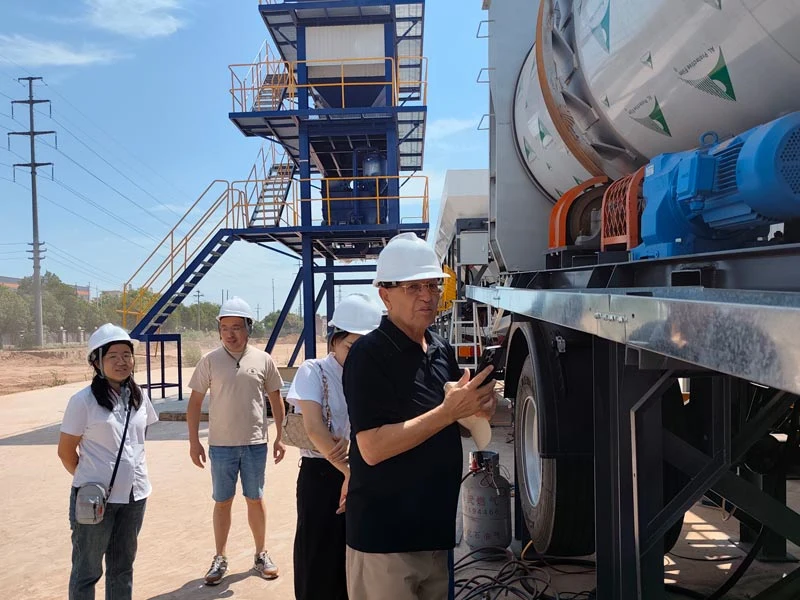
Modular Structural Design: Reducing Foundation and Installation Costs at the Source
- Recommended Practice: The costs associated with foundation work and installation during site relocation are largely determined by the structural design of the equipment itself. The higher the degree of modularity in the equipment, the lower the foundation engineering requirements at the new site, and the shorter the installation cycle—making these costs significantly more controllable.
- Macroad Mobile Asphalt Mixing Plant: Employs a “building-block” modular structural design where each functional module is independently formed. This results in simple foundation requirements at the new site, eliminating the need for complex foundation engineering. This directly saves on the concrete pouring costs typically incurred during the third phase of the project, while also shortening the waiting period required for foundation curing.
Rapid Disassembly, Assembly, and Connection System: Directly Reducing Labor Hours for Relocation
- Recommended Practice: The labor costs associated with disassembly and installation depend on the complexity of the equipment’s connection methods. The greater the number of connection points and the more specialized the required operations, the higher the proportion of skilled technical workers needed—making labor costs more difficult to control.
- Macroad Mobile Asphalt Mixing Plant: Equipped with quick-connect couplings and rapid connection systems for water, electricity, and gas. The main installation tasks do not require reliance on heavy-duty specialized machinery; general laborers can participate, thereby reducing the dependence on high-wage specialized technicians. From the moment the equipment arrives on-site until it enters full production, the entire cycle can be compressed to within 24 hours, directly minimizing the opportunity costs associated with production downtime.
AI Intelligent Operating System: Shortening the Team Ramp-up Period at New Sites
- Recommended Practice: The costs associated with team coordination and proficiency-building during the production ramp-up phase are directly correlated with the operational complexity of the equipment. The more complex the operation, the longer it takes for a new team to reach a state of stable production, resulting in greater efficiency losses during the ramp-up period.
- Macroad Mobile Asphalt Mixing Plant: Features an AI Intelligent Operating System that supports fully automated production workflows and one-touch recipe switching. This reduces the required operating staff from the traditional four personnel down to two. The system includes built-in functions for electronic inspections, fault pre-warnings, and maintenance reminders, allowing the new on-site team to achieve stable production status without a prolonged period of operational adjustment—thereby significantly shortening the ramp-up cycle during the fourth phase.
AI Precision Weighing System: Eliminating the Risk of Measurement Deviations During Commissioning
- Recommended Practice: Once installation is complete at a new site, the quality of the weighing system’s calibration directly determines the quality of the finished asphalt mix produced once operations begin. The more complex the calibration process, the longer the commissioning cycle; conversely, the lower the calibration accuracy, the higher the volume of wasted material and scrap generated during the production ramp-up phase.
- Macroad Mobile Asphalt Mixing Plant: The AI-driven precision weighing system supports automatic weight replenishment and variable-frequency screw conveyor control, achieving a metering error rate as low as 1%. Equipped with an electronic calibration tray, the calibration process can be completed by a single operator with high efficiency; once installation is complete, rapid calibration allows for immediate commencement of production. Precise metering directly reduces raw material waste, thereby preventing material losses and quality disputes caused by deviations in the mix ratio.
Remote Monitoring and Data Management: Equipment status remains fully traceable throughout the entire site relocation process
- Recommended Practice: The transparency of equipment status during a site relocation directly impacts the speed at which issues can be resolved. If equipment status remains invisible, problems often go undetected until they have escalated, leading to increased resolution costs.
- Macroad Mobile Asphalt Mixing Plant: Production data is continuously recorded and stored via a networked system, allowing management to monitor equipment operating status remotely and in real-time via a dedicated mobile app. The control system supports remote software upgrades, and environmental parameters for the new site can be adjusted remotely to ensure compatibility—eliminating the need to wait for technical personnel to arrive on-site. Comprehensive operational data from both before and after the relocation is securely archived, providing an objective basis for equipment condition assessments and the determination of accountability.
Macroad Team Support: Professional execution guarantees covering the entire site relocation lifecycle
- Recommended Practice: While equipment performance establishes the minimum cost threshold for a relocation, the quality of team support determines whether this theoretical minimum can actually be realized during practical execution. From pre-relocation assessment and planning to installation and commissioning, and finally to post-production follow-up, every stage requires professional support to ensure that planned cost controls are effectively implemented at the operational level.
- Macroad Team: Prior to relocation, the Macroad team assists clients in conducting a systematic assessment of relocation costs, identifying potential risks at each stage, and formulating corresponding mitigation strategies. During the installation phase, the team provides on-site technical guidance to ensure the rapid installation and commissioning of the equipment at the new site. Following the commencement of production, continuous remote technical support is provided to monitor operational status, ensuring the equipment maintains optimal performance within its new operating environment.
Based on our experience working with clients, successful project transitions often share a common characteristic: thorough preparation across three key dimensions—equipment infrastructure, system automation, and team support. A deficiency in any one of these areas will inevitably manifest as additional costs at some stage of the transition process. If you have any questions while planning your next transition, Macroad team would be happy to discuss them with you.
Relocation Is Where Cost Management Begins, Not Ends
The smoother the transition, the greater the project’s flexibility and the broader the scope of business it can cover. When the right equipment is selected and the team is fully in place, controlling transition costs becomes far simpler than one might imagine; indeed, this very capability serves as the most solid foundation for continuously expanding regional influence. If you are currently planning a transition or have any questions, please feel free to contact us at any time.