

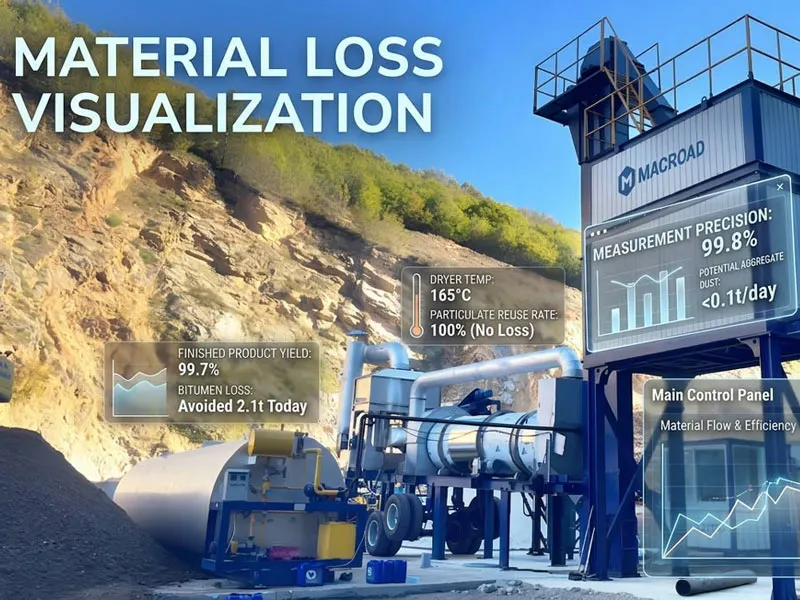
In actual production and construction processes, material loss is an ever-present reality, yet it is rarely subjected to detailed scrutiny. In most instances, we observe only the aggregate result of this loss, finding it difficult to answer a more specific question: at precisely which stages did these losses occur?
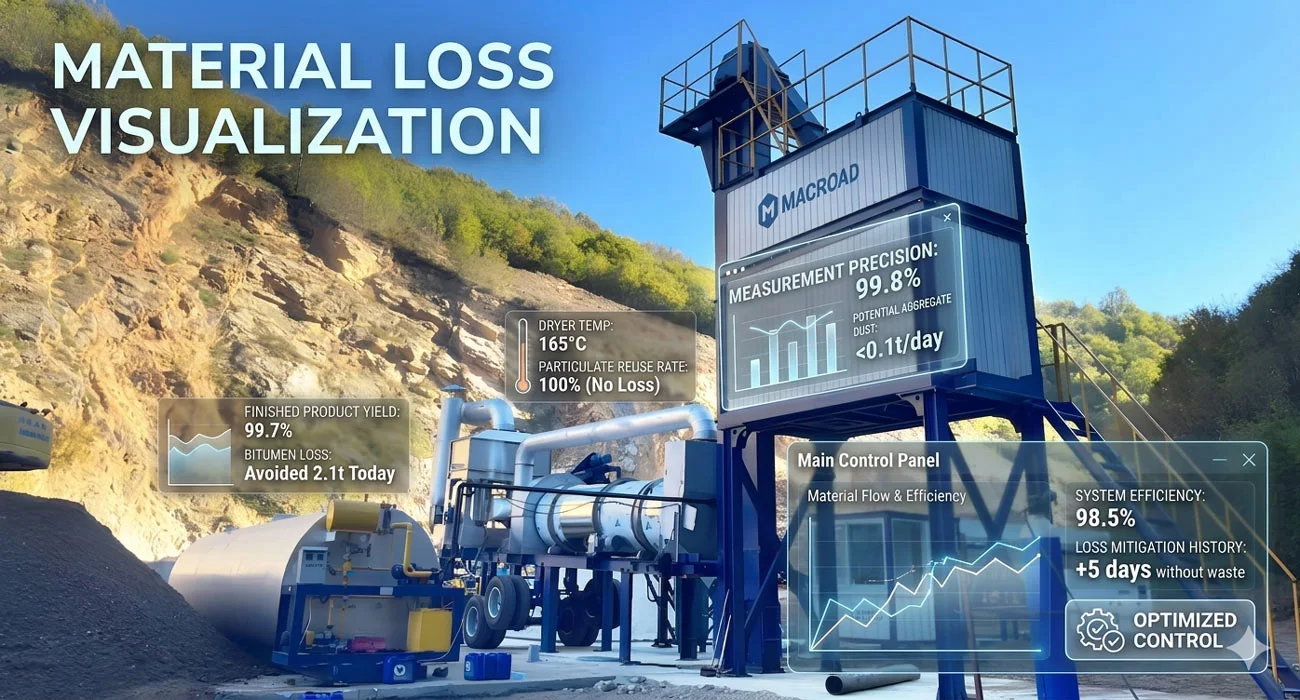
Did they stem from deviations in upstream material batching, or from fluctuations within the intermediate production process? Were they caused by changes in equipment operating conditions, or by the dynamics of the construction workflow? When these questions cannot be clearly answered, the loss itself becomes virtually impossible to effectively manage. It is precisely in this context that the concept of loss visualization has been introduced: by recording and disaggregating data from each individual stage, what was once an amorphous, generalized figure for total loss is broken down and revealed as specific variations occurring within concrete operational processes.
From Results to Process: Where Does Material Loss Actually Occur?
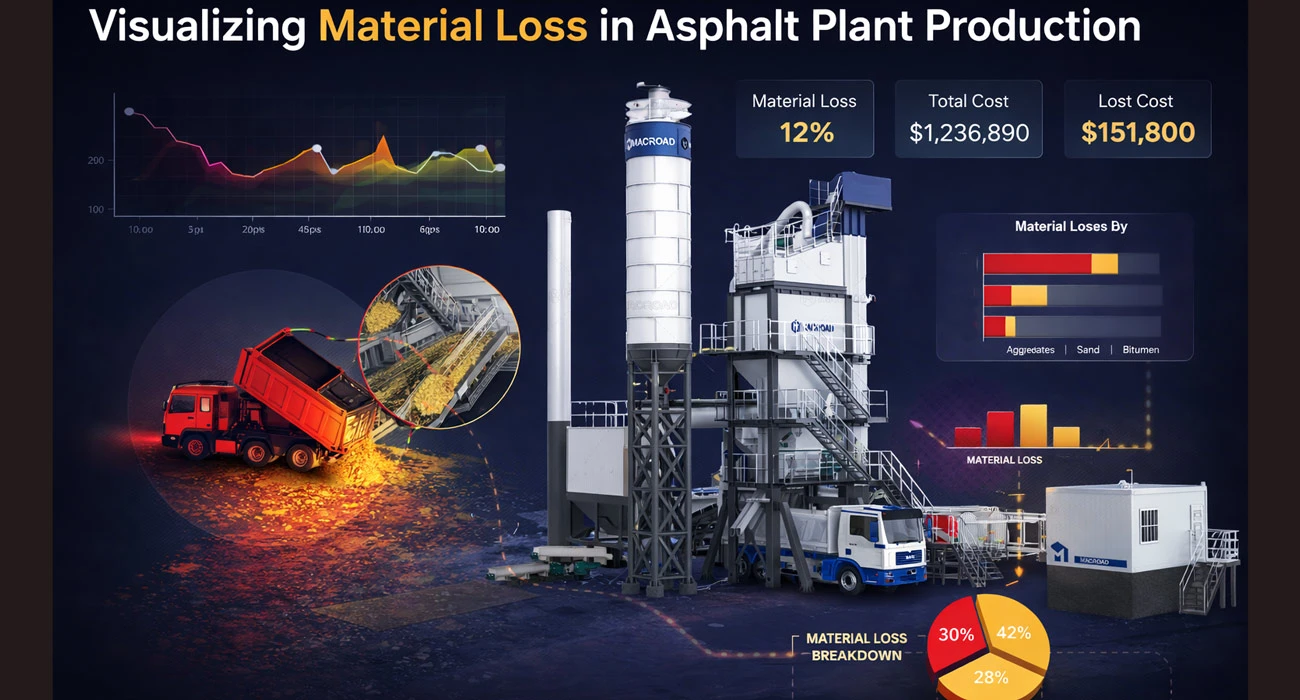
During the operation of an asphalt mixing plant, material loss is an ever-present phenomenon that permeates multiple stages of the process. The challenge, however, lies in the fact that these losses rarely manifest directly or in an obvious form; instead, they are dispersed across various operational systems and embedded within specific technical procedures and operational workflows. Precisely for this reason, many instances of material loss are not—as it might seem—non-existent, but rather simply difficult to identify.
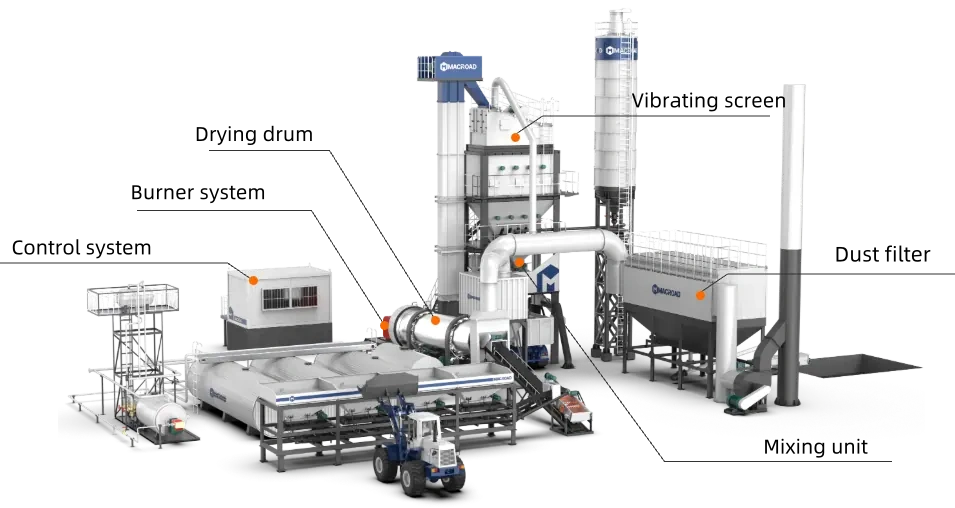
Cold Feed and Feeding System: The Starting Point for Amplified Initial Deviations
- Moisture Content Fluctuations → Reduction in Actual Effective Material: Inconsistent moisture levels across different material batches reduce the actual quantity of effective aggregate participating in production; however, metering remains based on total weight, resulting in a hidden loss.
- Uneven Feeding → System Supply Fluctuations: Instability in feeding speed or uniformity disrupts the operational rhythm of downstream systems, thereby compromising overall material utilization efficiency.
- Front-End Metering Deviations → The Source of System-Wide Errors: Once a deviation occurs during initial metering, all subsequent processing stages operate based on this existing error, leading to a gradual amplification of material losses throughout the entire process.
Drying and Heating System: Dual Impact on Energy Consumption and Material State
- Temperature Control Deviations → Abnormal Material State: Heating temperatures that are either too high or too low alter the physical properties of the materials, rendering certain portions unfit for use according to established standards.
- Combustion Efficiency Fluctuations → Increased Energy Consumption: Unstable combustion increases the energy required per unit of output while simultaneously diminishing drying efficiency.
- System Instability → Downstream Process Instability: Fluctuations in temperature and heating conditions directly compromise the stability of subsequent screening and mixing operations.
Screening and Hot Aggregate System: The Stage Where Structural Losses Are Amplified
- Screening Efficiency Deviations → Gradation Distortion and Material Misclassification: When screening efficiency is inconsistent, materials of different particle sizes cannot be accurately separated; some materials are misclassified or recirculated, resulting in deviations from the required aggregate gradation.
- Uneven Hot Aggregate Distribution → Reduced Material Utilization: Uneven distribution or unstable discharge of hot aggregate triggers deviations during subsequent batching operations; the system requires additional adjustments to match the target mix design, thereby incurring hidden losses.
- Recirculation and Overflow → Consumption Caused by Reprocessing: Materials that are not utilized in a timely manner undergo repeated processing cycles within the system, consuming both time and energy without contributing to effective output—a form of hidden loss.
Mixing and Metering System: The Stage Where Precision Errors Accumulate
- Metering Errors → Deviation from Design Mix Ratios: Even minor deviations during the weighing process directly cause the proportions of individual materials to diverge from the intended design values, establishing an initial error within the mix.
- Accumulation of Errors → Automatic System Compensation via Additional Material Input: To correct deviations in the mixing ratio, the system often executes compensatory adjustments; this results in increased material input and amplifies overall material loss.
- Uneven Mixing → Inefficient Local Material Utilization: Insufficient mixing leads to portions of the material remaining unutilized; this subsequently results in quality fluctuations or material waste during downstream application.
Transport and Construction Phases: The Stages of Final-State Degradation
- Temperature Degradation → Deterioration of Material Performance: A drop in material temperature during transport can compromise workability, rendering certain portions of the material unfit to meet required application standards.
- Time Delays → Alteration of Material State: Prolonged waiting periods cause the material’s properties to undergo gradual changes, thereby reducing its effective utilization rate.
- Mismatched Construction Pace → Rework and Excess Consumption: A misalignment between the construction schedule and the material supply flow can necessitate rework or result in material wastage, ultimately contributing to final material loss.
Viewed across the entire operational process, material loss is not concentrated within a single stage but is instead distributed across multiple systems, accumulating gradually as operations proceed. Crucially, these losses often manifest in forms that are extremely minute and diffuse; they do not trigger obvious anomalies within any single stage, nor are they easily or accurately identifiable through mere experience or visual inspection.
It is precisely against this backdrop that the visualization of material loss has emerged as a critical area of focus—it renders visible those operational details that were previously fragmented, thereby fundamentally reshaping our understanding of how such losses occur.
Why Material Loss Persists and Remains Difficult to Visualize
If the value of loss visualization lies in bringing problems into sharp focus, then a more critical question arises: Why is it that, in the past, these losses persisted for so long without ever being truly revealed?
The answer is not complex: it was not that the losses did not exist, but rather that the technological conditions and equipment capabilities available at the time were insufficient to support the detailed analysis and interconnection of these processes.
Technical Capabilities: Data Insufficient to Reconstruct Processes
- Limited Data Granularity; Inability to Capture Operational Details: Data collection often reflects only final outcomes and fails to reconstruct the specific changes occurring during intermediate stages, making it impossible to trace the root causes of losses.
- Fragmented Data Systems; Inability to Form a Complete Chain: Data across different systems often exists in isolation, lacking a unified data structure and interconnection mechanisms. Consequently, data from various stages cannot flow seamlessly, preventing a holistic, system-level visualization of losses.
- Lack of Real-time Data; Inability to Capture Dynamic Changes: Most data relies on retrospective recording rather than real-time capture. This means that fluctuations occurring during operations cannot be recorded promptly, resulting in loss assessment remaining largely a matter of subjective experience rather than objective data analysis.
Equipment Capabilities: Limited Operational Precision and Coordination
- Limited Equipment Control Precision; Difficulty Supporting Fine-Grained Management: In legacy equipment systems, operational control tends to focus on broad, holistic adjustments rather than precise control over specific individual stages. This control approach makes it difficult to isolate and identify subtle deviations.
- Insufficient System Coordination; Lack of Cross-Stage Linkage: Different pieces of equipment often operate relatively independently, lacking mechanisms for inter-linkage. When a deviation occurs in one stage, the system as a whole cannot respond or self-correct; consequently, the problem remains confined to a localized area.
- Insufficient Equipment Operational Stability; Compromised Data Reliability: If the equipment itself suffers from inherent instability—such as weighing errors or temperature control fluctuations—then even if data is recorded, its underlying reliability is compromised, further undermining the foundation for loss analysis.
Industry Environment: Management Practices and Requirements Have Yet to Drive Visualization
- Industry Focus Skews Toward Outcome Compliance, Not Process Control: Under traditional models, as long as the final output meets basic requirements, losses occurring during the intermediate process are rarely investigated in depth. This outcome-oriented mindset creates a lack of incentive to actively manage process-related data.
- Insufficient Standards and Regulations; Lack of Requirements for Data-Driven Management: Historical industry standards and regulations have tended to focus primarily on safety and quality outcomes, with fewer requirements regarding the granular management of process data and losses. Consequently, enterprises lack the external impetus to establish systematic data management capabilities.
- Management Relies on Experience; Low Degree of Data-Driven Decision-Making: Many decisions are based on the operational experience of personnel rather than on data analysis. In this paradigm, even if data exists, it is not fully utilized; naturally, this makes it difficult to systematically identify and address losses.
Taken as a whole, the reason material loss has long persisted yet remained difficult to visualize is not attributable to a single factor; rather, it is the result of the combined interplay of technical capabilities, equipment capabilities, and the broader industry environment. When these foundational conditions are not yet in place, loss exists primarily in the form of experiential knowledge, proving difficult to deconstruct into data-driven processes that can be continuously monitored and analyzed.
However, as these conditions gradually mature, the groundwork for rendering such losses visible begins to take shape—thereby establishing the practical prerequisites for the emergence of loss visualization.
Cognitive Shifts Driven by Material Loss Visualization
As material loss begins to be progressively revealed, the initial shift occurs in the very way the problem is conceptualized. In the past, loss was predominantly observed as an aggregate outcome; however, under conditions of visualization, this singular mode of perception is gradually being deconstructed.
As data becomes capable of being segmented and tracked, the focus of understanding shifts from merely observing results to comprehending the underlying processes—thereby establishing a new foundation for subsequent management and optimization.
| Traditional Understanding | Cognitive Dimension | Understanding with Loss Visualization |
| Loss is usually seen as an overall result, focusing on total loss values without breaking down sources or formation paths. | Understanding of Loss | Loss is decomposed into specific stages, such as batching, heating, screening, and mixing, forming a continuous process that is easier to understand and track. |
| Issues are often noticed only after results appear, leading to lag in detection. | Observation Timing | Deviations can be observed in real time during operation, allowing earlier problem detection. |
| Relies on operator experience and intuition, highly subjective. | Basis for Judgment | Judgments are based on data trends, providing stable and quantifiable insights, reducing reliance on personal experience. |
| Only overall anomalies can be identified; specific stages are hard to pinpoint. | Problem Localization | Problems can be traced to specific systems or steps, enabling precise tracking. |
| Result-oriented management; process changes are rarely addressed. | Management Approach | Management shifts to process monitoring, allowing interventions during operations to reduce losses. |
| Data mainly used for recording and statistics, referenced after the fact. | Use of Data | Data is actively used for analysis and decision-making, becoming a key tool for operation and optimization. |
| Systems operate relatively independently, with unclear interconnections. | System Understanding | System data can be linked; operations can be analyzed holistically. |
| Relies on experience-based adjustments, which are less consistent. | Optimization Approach | Dynamic optimization based on data, with more targeted and controllable adjustments. |
| Focuses on surface-level results; lacks insight into processes. | Cognitive Scope | Provides visibility into process fluctuations and trends, extending understanding to the operational level. |
Through loss visualization, material loss is no longer merely an abstract final outcome, but rather a process that can be deconstructed, tracked, and understood. This cognitive shift enables managers and operators to identify issues earlier and grasp causal relationships more clearly, thereby providing a solid foundation for subsequent optimization and decision-making. In other words, the primary value delivered by loss visualization lies precisely in reshaping—at a cognitive level—the way in which loss is perceived.
Reshaping Production Systems Through Material Loss Visualization
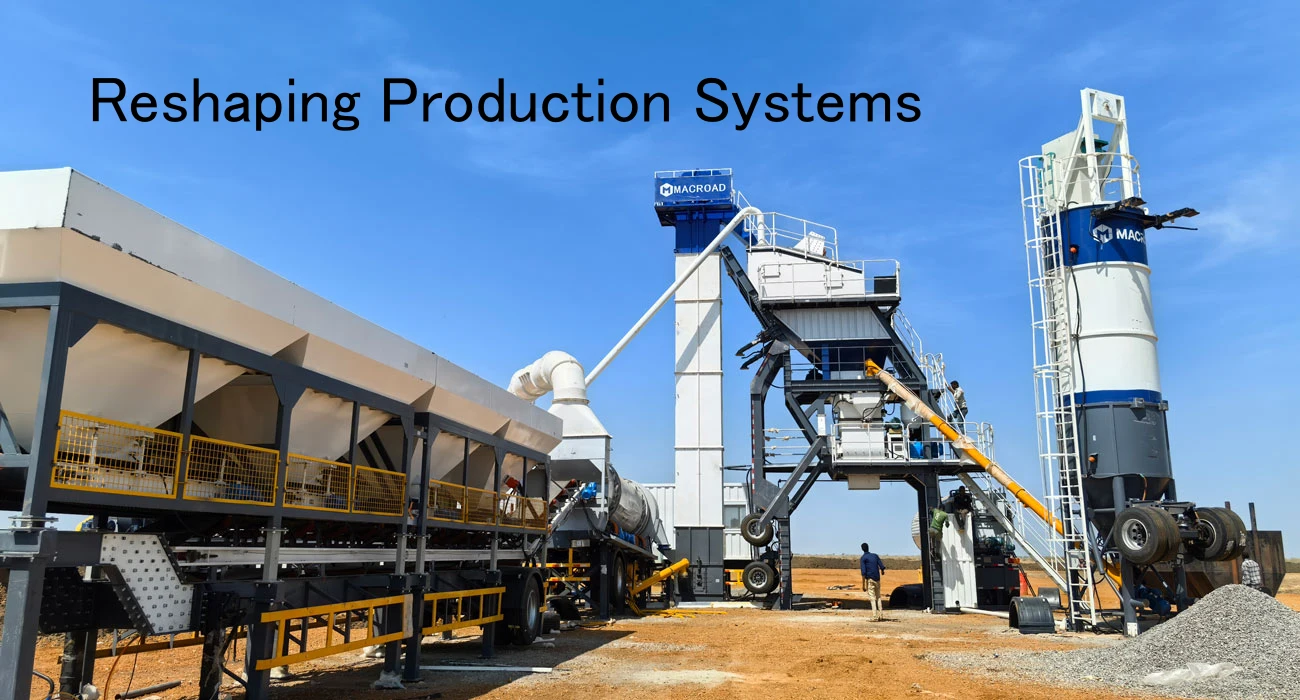
Once material wastage becomes visible, system operation ceases to be merely the mechanical execution of commands. Data from every stage can be tracked, and every deviation can be detected in real time. The production system begins to function as a sentient entity—one that not only executes operations but also proactively self-adjusts, rendering the entire process more flexible and efficient.
Under these conditions, the operational dynamics of every system undergo a marked transformation; spanning everything from control and data to processes and collaboration, every component is evolving toward greater dynamism and intelligence.
Control System: From Execution Tool to Regulatory Hub
- Real-time Deviation Response: The control system is no longer merely an executor of preset programs; instead, it collects data from every stage in real time, automatically adjusting for deviations to ensure operational stability.
- Proactive Production Regulation: By analyzing both historical and real-time data, the system can anticipate potential issues and intervene preemptively, transforming control from passive execution into proactive regulation.
- Multi-Stage Coordination: The control system simultaneously manages batching, heating, mixing, and conveying processes, achieving optimized linkages between stages rather than relying on isolated, single-point operations.
Data System: From Recording Tool to Decision Engine
- Real-time Data Acquisition: Data from every stage is collected synchronously during the production process, making operational fluctuations immediately visible rather than merely serving as retrospective statistics.
- Data-Driven Production: Data serves not only to record results but also to dynamically adjust parameters—such as mix ratios, temperatures, and mixing speeds—enabling agile, data-driven production decisions.
- Analysis and Optimization Loop: Through multi-stage data analysis, the system identifies issues and opportunities for improvement, facilitating continuous process enhancement and effective loss control.
Production Workflow: From Fixed Sequence to Dynamic System
- Flexible Process Adjustment: Production no longer adheres strictly to a fixed sequence; the system can adjust the pace based on real-time data to adapt to variations in raw materials and specific project requirements.
- Automated Anomaly Handling: If an anomaly occurs at any stage, the system automatically adjusts subsequent stages to mitigate the risk of escalating losses or potential downtime.
- Holistic Efficiency Enhancement: The dynamic workflow ensures tight integration across all stages, minimizing idle time and bottlenecks while maintaining consistent output levels and optimal material utilization.
Management and Optimization: From Experience-Driven to Data-Driven
- Real-time Monitoring and Early Warning: Managers gain real-time visibility into data fluctuations across all stages, receiving early warnings regarding potential deviations to reduce the burden of retrospective troubleshooting.
- Data-Informed Decision-Making: Decisions are no longer based solely on intuition or experience, but are instead grounded in visualized data and analytical insights, making management more scientific and quantifiable.
- Continuous Optimization Capability: Based on data feedback, the system continuously refines process parameters and production strategies, driving long-term improvements in operational efficiency and material utilization.
Through the visualization of material loss, the production system transcends the status of a mere mechanical assembly line, evolving instead into a dynamic entity that is sentient, adaptable, and capable of self-optimization. The control system serves as the central regulatory hub, with data driving production decisions and facilitating collaborative operations within this new procedural framework; concurrently, managers gain the ability to maintain a real-time, comprehensive overview of the entire operation.
This transformation not only enhances production efficiency but also renders loss management and process optimization into sustainable and quantifiable processes.
Material Loss Visualization Drives Process and Technology Upgrades
When material loss can be precisely monitored and visualized, new possibilities emerge for process and technical optimization. Deviations, fluctuations, and inconsistent material usage are no longer overlooked; instead, production stages can be finely tuned based on real-time data, thereby enhancing material utilization, optimizing ratios, and achieving more stable process operations.
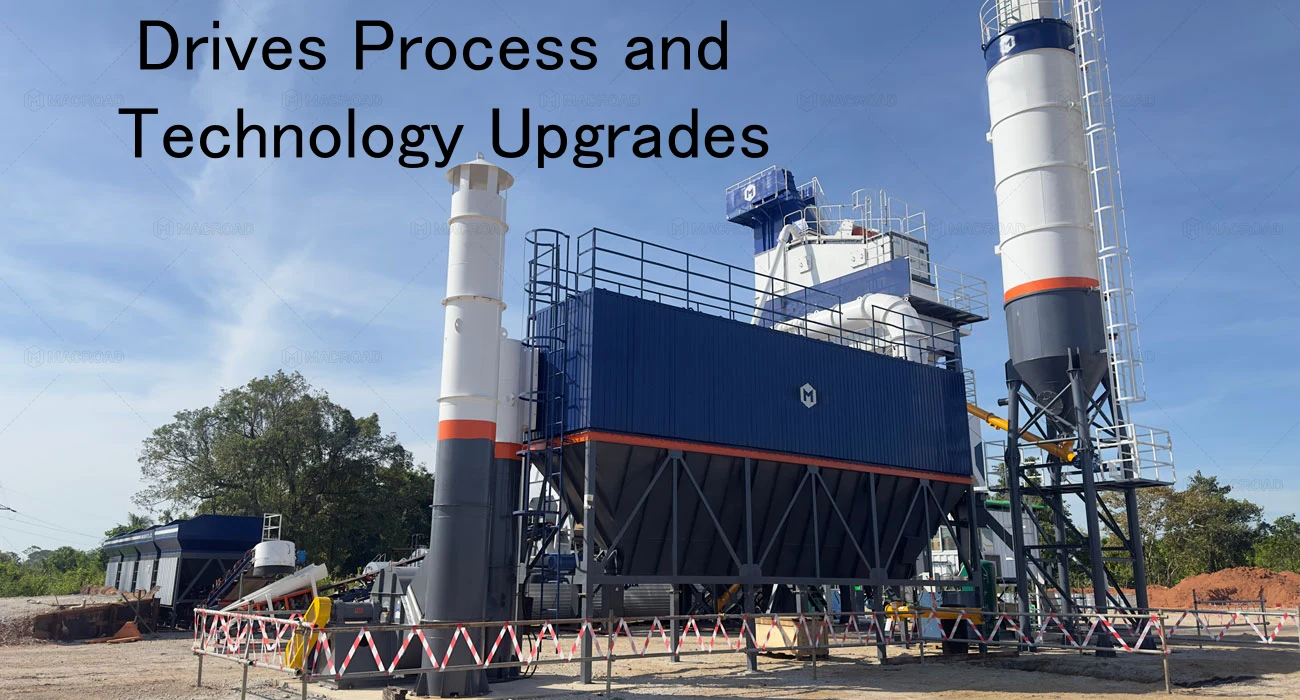
Under these conditions, process technology no longer relies on empirical experience but becomes data-driven—evolving into a more scientific and controllable discipline.
Ratio Optimization: Precise Control Over Material Usage
Loss visualization ensures that ratio adjustments are no longer reliant on subjective experience but are instead data-driven, achieving an optimal balance in material usage while simultaneously enhancing mixing quality and product consistency.
- Accurate Quantification of Deviations: The system displays, in real-time, the discrepancy between the actual consumption of each raw material and its ideal ratio. This enables operators to make precise adjustments, keeping the deviation for each batch within ±0.5% and reducing material waste by approximately 3–5%.
- Data-Driven Ratio Strategies: By analyzing historical and real-time data, the system optimizes raw material proportions. This boosts overall material utilization efficiency by 4–6%, improves mixing homogeneity, and maintains a consistent pass rate of over 98%.
- Reduction of Human Error: Operations are guided by data rather than subjective experience, leading to greater operational consistency. This results in a reduction of approximately 30% in the number of rework instances caused by human errors in material weighing and mixing.
Dynamic Adjustment of Process Parameters: Real-Time Production Responsiveness
Loss visualization enables the dynamic adjustment of key process parameters based on changing production conditions and material characteristics, thereby enhancing production stability and material utilization efficiency.
- Real-Time Monitoring of Key Parameters: Parameters such as temperature, stirring speed, and heating duration are continuously tracked. This keeps temperature fluctuations within a tight range of ±2°C, reducing losses caused by overheating or insufficient heating by 2–3%.
- Rapid Response to Material Variations: When deviations occur in raw material moisture content or temperature, the system automatically adjusts process parameters. This reduces the rate of mixing non-uniformity by approximately 25% and significantly improves product stability.
- Containment of Loss Propagation: Dynamic adjustments prevent deviations from accumulating and cascading into subsequent production stages, resulting in a 5% reduction in overall material loss and a 10% decrease in the number of batches requiring rework.
Enhanced Material Utilization: Maximizing the Value of Every Unit of Raw Material
Loss visualization helps identify hidden sources of waste and optimizes usage efficiency, ensuring that raw materials are fully utilized at every stage of the production process.
- Identification of Hidden Losses: The system reveals waste points that are often imperceptible during traditional operations—such as inefficiencies in material conveying or mixing—reducing the proportion of such hidden losses by approximately 2–3% and generating direct savings on raw material costs.
- Optimization of Material Flow and Handling: Based on visualized data, improvements are implemented in material conveying, storage, and mixing methods. This reduces material residue by 15% and boosts overall raw material utilization efficiency by 4%.
- Enhance Overall Production Efficiency: Optimized utilization directly impacts output; yield per unit of raw material increases by 3–5%, while waste disposal costs are simultaneously reduced.
Temperature System Optimization: Precision Control Minimizes Loss
Loss visualization renders temperature control data visible in real-time, enabling the timely detection and correction of temperature deviations during heating, storage, and conveying stages, thereby reducing material loss caused by temperature anomalies.
- Real-time Temperature Monitoring: The system continuously provides feedback on raw material heating and storage temperatures; operators can make immediate adjustments based on deviations, keeping temperature fluctuations for each batch within ±2°C and improving mixing uniformity.
- Dynamic Heating Adjustment: Visualized data guides the dynamic adjustment of heating power and duration, preventing rework caused by overheating or underheating, and boosting raw material yield per unit by approximately 3%.
- Anomaly Alerts & Closed-Loop Optimization: Temperature control deviations trigger automatic system alerts and are recorded, providing a basis for operational optimization; this enhances long-term temperature control stability, reducing overall material loss by approximately 3–4%.
Mixing & Agitation Optimization: Real-time Adjustments Boost Material Utilization
Loss visualization quantifies the mixing status during the agitation phase, allowing both operators and the system to make real-time adjustments to agitation speed, blade angle, and duration, thereby improving material uniformity and utilization efficiency.
- Mixing Uniformity Monitoring: The system displays the material distribution within the mixer; deviations are corrected in a timely manner, reducing mixing variance by approximately 10% and lowering localized material loss by 3%.
- Dynamic Parameter Adjustment: Agitation cycles and blade angles are adjusted based on real-time data to ensure that every batch of raw material is thoroughly mixed, resulting in a 3% increase in raw material yield per unit.
- Agitation Efficiency Optimization: Visualized data helps identify inefficient batches and optimize operational modes, boosting overall agitation efficiency by 5%—with a corresponding increase in material utilization.
Conveying & Storage Optimization: Minimizing Process Losses
Loss visualization makes material flow and consumption during the conveying stage fully traceable, enabling operators to adjust conveying speeds and batch intervals accordingly, thereby preserving material integrity and reducing loss.
- Conveying Path Visualization: The system displays the actual throughput of conveyor belts and elevators; deviations are addressed promptly, reducing conveying-related material loss by approximately 2%.
- Refined Rhythm Control: Adjusts speed and batch intervals based on real-time conveying data to prevent material accumulation and spillage, thereby increasing material utilization per batch by approximately 2–3%.
- Long-Term Data Tracking: Provides visual records of historical data to serve as a reference for optimizing the conveying process, resulting in a long-term increase in material utilization of approximately 4% and a significant reduction in invisible losses.
Loss visualization renders every stage of production quantifiable and traceable—from ingredient formulation and process parameters to temperature control, mixing, and conveying—enabling both operations and systems to undergo real-time, data-driven adjustments. The result is enhanced material utilization, reduced localized waste, and improvements in mixing uniformity and production efficiency; by making previously invisible losses explicit, this approach becomes a core driving force for process optimization and cost control.
How Material Loss Visualization Reshapes Management and Profit Models
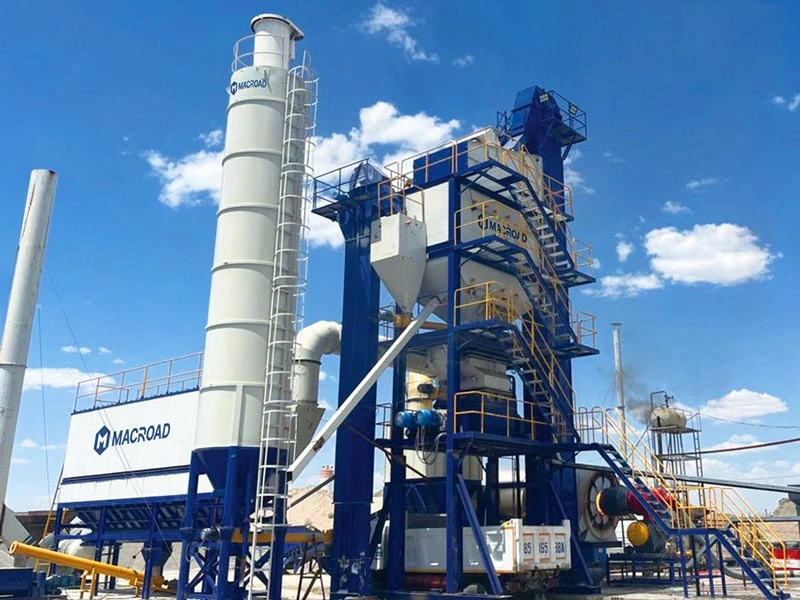
As the application of loss visualization matures within operational and technical processes, the value it generates extends beyond mere improvements in production efficiency and material utilization; it directly impacts an enterprise’s management practices and profit models. By rendering losses visible, quantifiable, and trackable, companies can uncover previously overlooked cost centers, optimize management workflows, and thereby unlock their full profit potential.
This represents not merely an effort to reduce waste, but a comprehensive transformation—spanning everything from cost control and efficiency enhancement to strategic decision-making.
Cost Structure Optimization: Dual Savings in Materials and Labor
Capacity Management Optimization: Stabilizing Output and Boosting Equipment Utilization
Decision Support Optimization: Data-Driven, Granular Management
Risk and Budget Management Optimization: A Preventive Approach
End-to-End Cost Transparency: Restructuring the Profit Model
The Technical Requirements for Material Loss Visualization
Loss visualization represents a core transformative shift in the future production management of asphalt hot mix plant; however, its practical implementation still faces technical and systemic challenges. Only by establishing robust mechanisms for data acquisition, intelligent analysis, and real-time feedback can losses be truly rendered explicit.
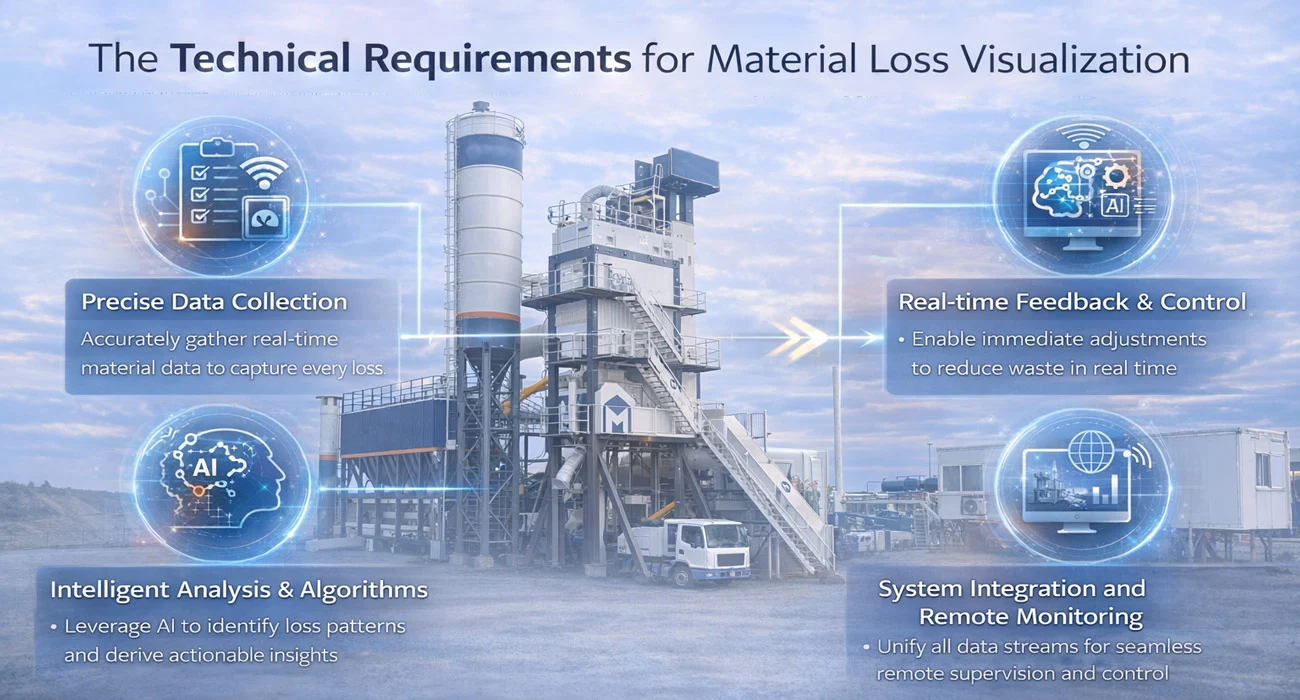
Precise Data Collection: The Foundation of Visualization
The first step in visualization is the precise collection of data from every stage of the process—including weighing, temperature, material flow, and mixing status. Without high-precision data, any subsequent analysis or feedback risks deviating significantly from reality.
- Implementation Path
- High-Precision Weighing: Weighing systems for aggregates, powders, and asphalt must achieve an accuracy of ±0.5% to prevent the accumulation of errors at the front end of the process.
- Temperature Control & Humidity Monitoring: Real-time data on heating and storage temperatures is collected to ensure material property consistency and prevent hidden losses.
- Mixing & Flow Monitoring: Sensors are installed to monitor the actual material flow within mixers and conveying systems, providing a reliable foundation of raw data.
- Current Gaps: Many enterprises still rely on experience-based operations or manual record-keeping; real-time, high-precision data collection has yet to become widespread. This constitutes the primary hurdle to achieving true visualization.
- Macroad’s Optimization Focus: Upgrading weighing accuracy and temperature control systems, along with installing sensors at critical process points, to ensure data integrity and lay a solid foundation for visualization.
Intelligent Analysis & Algorithms: The Brain of Visualization
Data alone is insufficient; visualization requires an intelligent analysis system to transform raw data into actionable information—identifying anomalies, predicting loss trends, and guiding real-time decision-making.
- Implementation Path
- Batch Data Analysis: Algorithms are employed to calculate deviations and identify the sources of loss for each production batch, clearly pinpointing areas for improvement.
- Real-time Anomaly Detection: The system automatically triggers alerts regarding fluctuations in weighing, temperature control, or mixing parameters, guiding operators to make necessary adjustments.
- Trend Prediction & Optimization: Historical data and algorithms are utilized to predict potential areas of waste, providing an evidence-based foundation for process optimization decisions.
- Current Gaps: Many existing enterprise systems are capable only of recording data; they lack intelligent analysis and trend-prediction capabilities. Consequently, their visualization remains limited to merely identifying problems without providing actionable guidance for decision-making.
- Macroad’s Optimization Focus: Continuously iterating AI algorithms to enhance the accuracy of anomaly detection, thereby enabling the practical application of batch analysis and trend prediction within the production environment.
Real-time Feedback & Control: The Execution Power of Visualization
The ultimate value of data and analysis is realized through dynamic adjustments made within the production process itself. Visualization must possess the capability to translate identified deviations and recommended actions into concrete operational adjustments or automated system controls.
- Implementation Path
- Automated Control Adjustment: Feeding, mixing, and temperature control parameters are automatically adjusted based on real-time data to achieve dynamic process optimization.
- Operational Feedback Mechanisms: Operators are alerted to anomalous batches or parameter deviations, ensuring timely intervention and corrective action.
- Closed-Loop Verification: Feeding the results of adjustments back into the system to establish a closed-loop management cycle of Discovery—Adjustment—Verification.
- Current Gap: Most enterprises still rely on manual adjustments and lack real-time closed-loop mechanisms, resulting in a time lag between visualized insights and operational execution.
- Macroad’s Optimization Approach: Introducing an intelligent control system and real-time mobile app alerts to create an Operation-Data closed loop, thereby enhancing adjustment efficiency and execution capabilities.
System Integration and Remote Monitoring: A Visualized Global Perspective
Visualizing loss extends beyond merely improving individual process steps; it necessitates full-process system integration to achieve unified data management and remote monitoring.
- Implementation Pathway
- Full-Process Data Integration: Unified collection and storage of data from equipment, temperature control systems, mixing units, and conveying systems.
- Remote Monitoring and Management: Managers can view data from every stage via a centralized platform or mobile devices, enabling them to issue optimization directives in a timely manner.
- Historical Records and Reporting: The system automatically generates trend analyses and reports to support long-term optimization initiatives.
- Current Gap: In some enterprises, systems are fragmented and data silos are severe; the lack of global visualization capabilities prevents management from intuitively grasping the complete picture of production losses.
- Macroad’s Optimization Approach: An IoT platform integrates data from all process stages, providing remote monitoring and historical analysis reports that enable management to maintain a comprehensive, global overview of production status.
The core of visualizing material loss lies in robust technical support: high-precision data acquisition, intelligent analytics and algorithms, real-time feedback loops, and system integration. Through the optimization of equipment precision, AI-driven intelligent analytics, and remote monitoring platforms, Macroad is progressively bridging the gap toward the practical realization of visualization. This transforms material loss—previously merely a visible outcome—into a fully integrated resource that is quantifiable, manageable, and optimizable across the entire process, thereby driving enhanced efficiency and cost optimization.
From Loss Visibility to Efficiency and Value Reinvention
As technologies and systems continue to evolve, the visualization of material loss is driving the asphalt mixing industry’s transition from an experience-driven approach to a data-driven one. This not only renders material loss explicitly visible but also fosters a tight integration among production processes, system operations, and management decision-making, thereby achieving comprehensive optimization across efficiency, cost, and quality.

Looking ahead, as equipment precision improves, intelligent analytical capabilities strengthen, and management models innovate, material loss visualization is poised to become an industry standard. It will empower enterprises to uncover untapped potential and unlock value, ultimately guiding the entire sector toward a development model that is more efficient, refined, and sustainable.